
4 widely recognized 'control' layers plus 3 contenders

SIGA's self-adhering waterproof membrane being installed on a new build in Yarmouth. PHOTO COURTESY OF KOLBERT BUILDING
What's your number?
By Dan Kolbert
THIS ISSUE, we don’t have to count very high! Constructing a home that is efficient, resilient and healthy for the structure and occupants for many years to come involves consideration of several key material layers or, as we call them, control layers.
For the past 15 years or so, we’ve been talking about the four control layers as the easiest way to understand some basic building science and best practices. A control layer is simply a material (or materials) that separate conditions on either side of it, like a raincoat gets wet on the outside but stays dry (hopefully!) on the inside.
Every homeowner, no matter their home’s location or climate, should think about these four control layers. Obviously, the solutions will be different in Millinocket and Miami, but the basic physics of heat and moisture movement are the same.
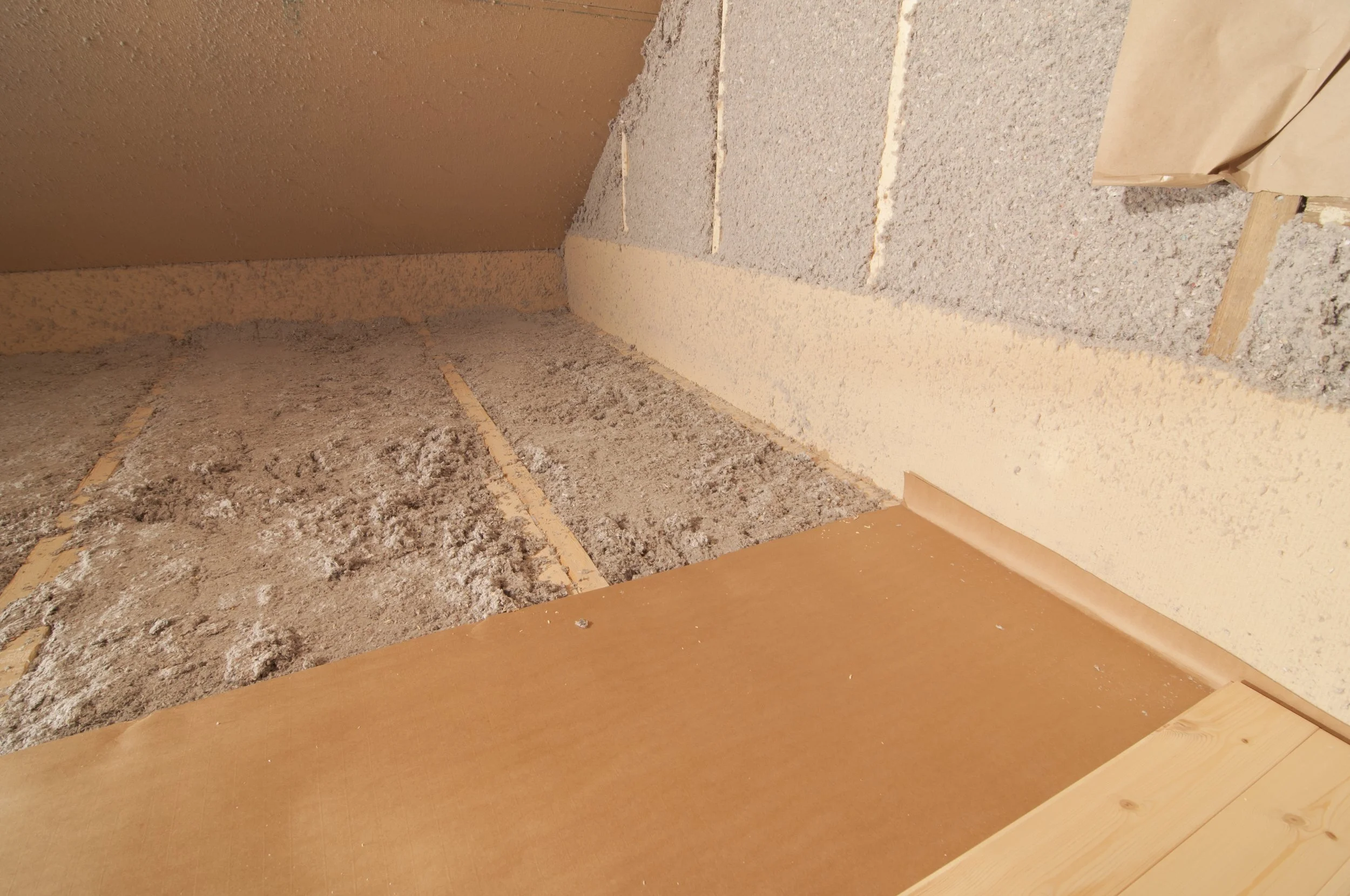
Dense-pack blown cellulose being installed in an attic.
The four control layers are:
1. Water Control Layer
This is the anchor for all the other layers. If your house leaks, it doesn’t matter much how well anything else works. The components include water-resistive barriers (WRBs) like a house wrap or taped sheathings (e.g., ZIP System®), roof, basement waterproofing, siding, flashing, overhangs and anything else designed to keep rain, snow and groundwater out of the house.
2. Air control layer
The air seal can be inside, outside, or in the middle and can be comprised of multiple materials or part of the other control layers. But it needs to be continuous.
3. VAPOR CONTROL LAYER
Air-borne moisture can travel into your walls and ceilings, condense, and cause mold, rot and other serious problems. To avoid that, we typically try to retard the movement
4. THERMAL CONTROL LAYER
Simply stated, this is insulation, or anything that keeps the heat on one side and the cold on the other. Doors and windows are also part of this layer.
Recently there have been various candidates for admission to the control layers club. Let’s look at them one by one.
Wildfire
Sometimes called, more impressively, the Wildland Urban Interface. Some parts of the country (and world) have been dealing with wildfires as a routine occurrence for ages. But as we’ve seen from Quebec, Vermont and other very close places, it’s only a matter of time before parts of our heavily forested state go up in flames. Last year the California chapter of the U.S. Green Building Council (USGBC-CA) published a study called the California Wildfire Rebuilding Guide that looks at ways to make buildings more resilient and resistant in fire zones. Much of it has to do with creating a control layer around the building: landscaping, irrigation, decks, and so forth. But the study also looks at ways to protect the building itself from fire, floating embers, smoke and other risks. We have, belatedly I fear, started taking wildfire resilience much more seriously in our work. No house should be built without a strategy for wildfires.

A bathroom being insulated with Rockwool insulation for sound dampening. PHOTO COURTESY OF KOLBERT BUILDING
ACOUSTIC
In an increasingly busy, over-stimulating world, our mental equilibrium can depend on being able to get away from the noise. A well-insulated house tends to be much quieter to begin with. Triple-glazed windows also block out a lot of noise. Inside the house, there are various ways to separate noise from one part of the house from others. Like other control layers, this requires planning and integration into construction from the very beginning.
RADON
Smoking accounts for about 85% of lung cancer cases worldwide. Of the remainder, radon is the leading cause. With about 2 million deaths worldwide each year, 15% is still a big number. As we spend more and more of our lives indoors, the risks of exposure to radon increase.
Maine’s state building code requires radon mitigation measures for all new construction (ASTM E-1465-2008). The basic system involves burying perforated pipe under the slab (either on grade or in the basement) and running an exhaust pipe from the slab to the exterior. Often, this is enough to keep radon levels below the EPA threshold (4 pCi/L), but if not, attaching a fan to the exhaust pipe will suck all the gas from under the slab and out of the house.
The vast majority of homes in Maine are older than the radon standard, and Maine has the 13th-highest level of radon by state. The American Lung Association estimated in 2024 that 36.5% of homes in Maine had high radon levels. Setting up a radon system in an existing home is more complicated than in a new build, though still fairly routine.
It typically involves establishing a control layer at the slab by sealing cracks and closing off penetrations. Then a small pit is dug and filled with gravel, with a cover sealed to the concrete. A vent pipe runs from the cover to the exterior, with a fan attached. The fan depressurizes the space under the slab, creating a vacuum that sucks the sub-soil gases to the outdoors before they can enter the house. In some cases, a balanced ventilation system (like a heat recovery ventilator) may be enough to bring radon levels below the EPA threshold.
All homes should be tested for radon. And, because homes get remodeled and sub-soil conditions can change, they should be tested repeatedly. The EPA recommends that any test over two years old shouldn’t be relied on. The good news is that radon tests are inexpensive, and Maine has many labs that can both send you the test kits and perform the analysis. There’s also a new generation of inexpensive, real-time radon sensors. Kolbert Building recently donated one to the Portland Public Library to loan out, and we are trying to get more libraries interested.
The first four control layers became commonly accepted thanks to increasing knowledge and experience. We’ll see if research and practices lead to adoption of any of the others.
Read more: What’s Your Number?












This article appeared in the Spring 2026 edition of Green & Healthy Maine HOMES. Subscribe today!
Find Maine experts that specialize in healthy, efficient homes in the Green Homes Business Directory.