
What’s new in sustainable siding
PHOTO: FRANCOIS GAGNE
By Chris Briley and Ashley Nowicki
This article serves as an expansion or update to my piece Sustainability and Siding from the Fall 2019 issue of this magazine. While it is not a prerequisite for this article, I do recommend reading the previous one.
THE WORLD OF CONSTRUCTION products—including siding—is massive and changes all the time as new products come on the market. Keeping up requires vigilance.
SIDINGS WE USE LESS
As sustainable architects, we rarely find ourselves specifying fiber cement siding or vinyl siding. These tend to be budget options (vinyl especially) and still have their place in the market, though they have their flaws from a sustainable architect’s perspective. Fiber cement siding such as James Hardie, Nichiha or CertainTeed products are mostly made of silica. Although silica is an incredibly abundant material, there are manufacturing and installation health issues to consider: Silica dust can be very harmful when inhaled. It also has a high level of embodied carbon, meaning its production emits comparatively high levels of greenhouse gases.
Vinyl siding (the cheapest option by far) is a polyvinyl chloride (PVC) product. It is a chlorinated petroleum-based plastic that is toxic to make, difficult to recycle, and toxic to dispose of at the end of its use. It decomposes extremely slowly, but as it does, PVC leeches out dioxins, which is one reason why our plumbing supply pipes are not PVC. While installed on your house, however, it’s basically inert and perfectly safe. (Unless the house catches fire; then the resulting smoke is highly toxic.)
The marketing for both of these types of siding say they are “maintenance-free.” But let’s be clear. There’s no such thing as maintenance-free siding. It’s true that fiber cement will need to be painted less often than wood. But it will need to be painted and is still susceptible to moisture issues like wood is (though maybe less so). Vinyl expands and contracts greatly with temperature changes. Over time it will get brittle and often becomes unfastened in places and sometimes breaks.
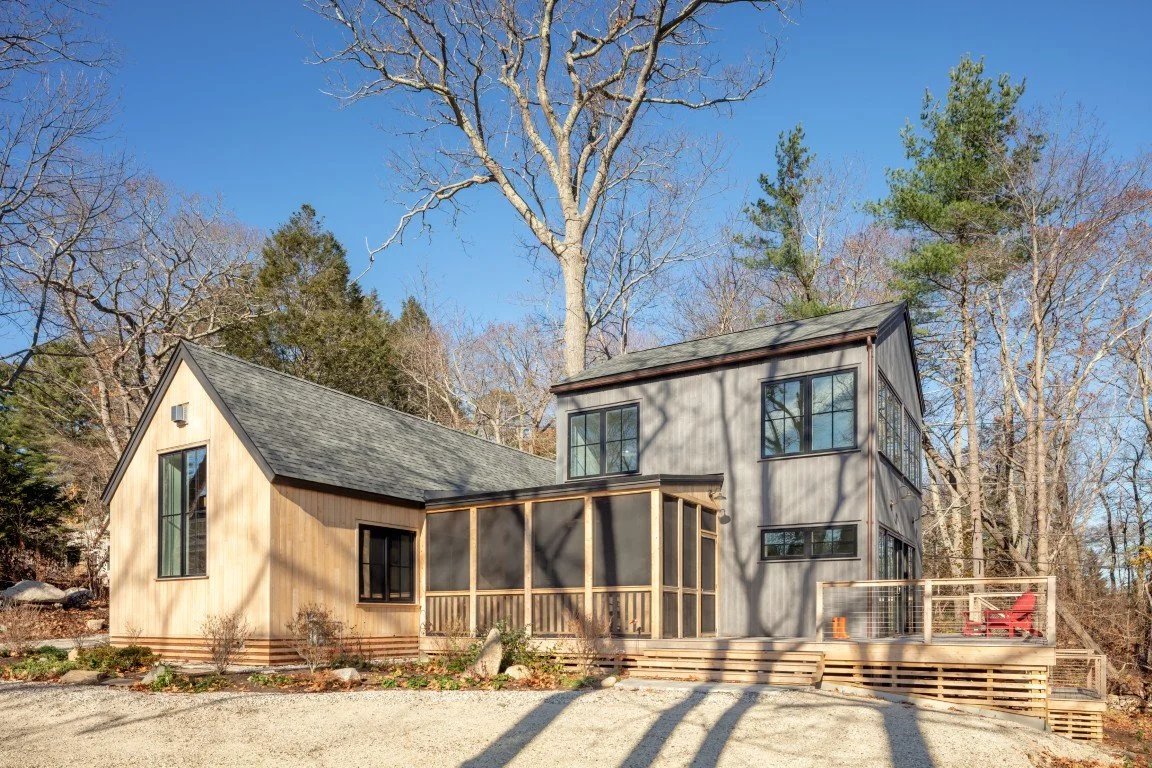
This Cumberland home renovation used vertical white cedar (Maine Cedar Store).. Clear finish on one volume, gray stain on the other. PHOTO: IRVIN SERRANO
GOOD OL’ WOOD (SPRUCE, PINE, FIR, HEMLOCK, LARCH, CEDAR)
Illustration based on Local Wood WORKS Maine Wood Guide map. Find more wood products businesses at localwoodworks.org/products.
We have seen a return to some of the classic sidings of the past. These softwoods are delightfully easy to tool and work, yielding many variations in size, profile and orientation. With the possible exception of cedar, these woods should be protected by applying paints or stains. Because cedar is highly resistant to rot, it can remain untreated with few issues. Even so, anticipate variations in color as it ages. It will gray where it sees rain and moisture and darken where it sees both sun and moisture.
One of the greatest attributes of wood siding is that it can be a local resource. In Maine we are blessed with sustainably managed forests and local mills that sell direct to consumers. This is an effective way to improve the sustainability of your wood. Although it may require additional effort, conducting targeted research can help you identify valuable deals on highly localized products (see the article on how to read lumber stamps on page 23). Less processing and handling involved in a product usually results in less embodied carbon and secondary chemicals used for its production. This makes wood, especially eastern wood, attractive to the sustainably minded. (Note that Douglas fir and red cedar typically come from the West Coast and, therefore, there’s a lot more travel and handling involved.)
BLACK LOCUST
There are times when a homeowner or designer is looking for a very durable and attractive wood with which to clad their project. Traditionally, they would begin to look at tropical hardwoods such as mahogany, Ipe or teak (or their respective families). But, in recent years, the availability of black locust siding (and decking) has given sustainable designers a durable hardwood option that is not a tropical one. Even as durable as these tropical hardwoods are, they cannot be considered sustainable if they are from faraway places that are highly susceptible to deforestation and political strife. Using a regional hardwood that is comparable in durability is an ideal alternative. White oak, for example, is remarkably hearty and can be used as exterior siding or decking, but since it is slow- growing and quite expensive, it’s reserved for more finished features. Black locust, however, grows more rapidly and across the Mid-Atlantic and Midwest. And while still pricey, it is significantly less than oak.
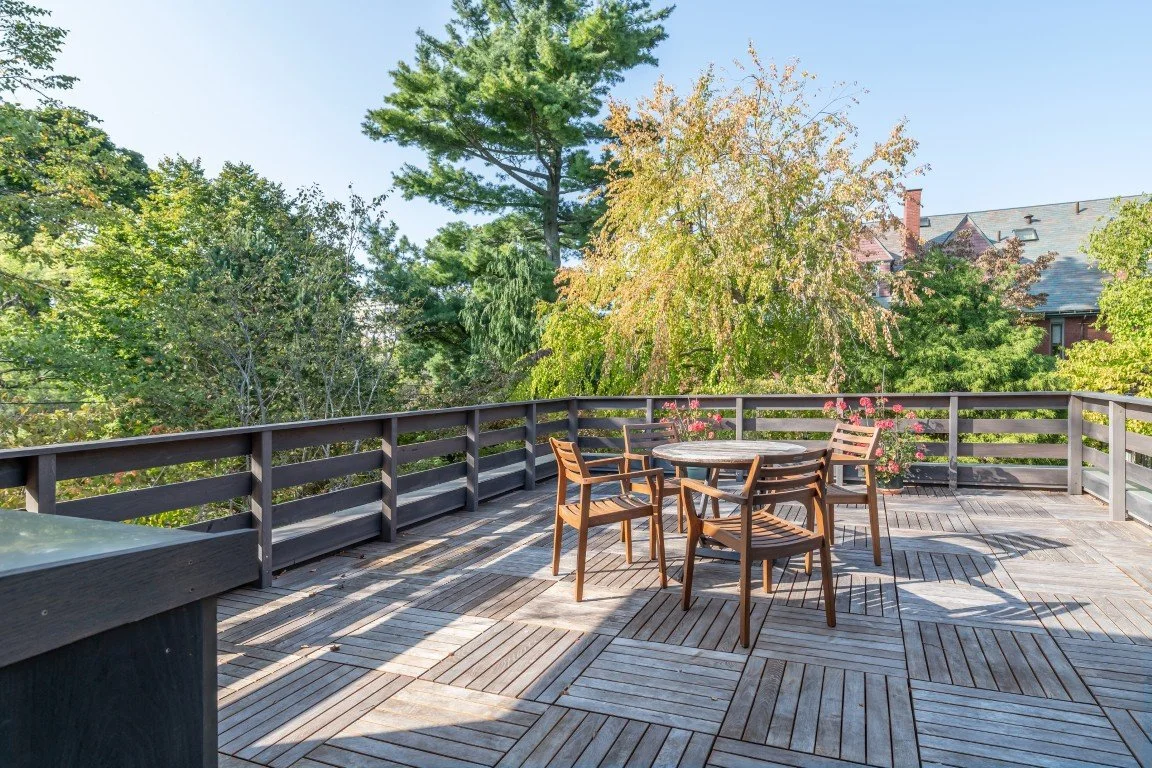
Black Locust is hearty enough to be used as a deck, like this roof deck in Portland. PHOTO: FRANCOIS GAGNE
IMPORTANCE OF THE RAINSCREEN
Imagine a piece of watercolor paper: When you paint one side with a lot of water, it immediately starts to warp and bend. Wood is just like this; it expands as it absorbs water and contracts as it dries. It is, therefore, imperative that wood is equally treated on all sides (primed, stained, or painted) and that the siding is installed over an air channel that allows the backside of the siding to dry as well as the front. This will dramatically reduce any cupping, twisting, or splitting of the wood as it ages, and it will hold its finish much longer. The term “rainscreen” refers to this type of installation where the siding is installed over strapping (vertical strips of wood) to allow air to freely flow behind it. In the case of shingles, a sheet of plastic fibers in ¼-inch loops is used to create this continuous air gap. In short, wood that is able to dry will last an incredibly long time, and a rainscreen installation will do this.
PRE-FINISHED SIDING AND THE EFFECT OF TARIFFS
There are times when it is advantageous to use a pre-finished wood siding, either for speed or to save on labor. In the past, we had some good Canadian options no longer available in the United Statea due to tariffs. Domestic alternatives include Robbins Lumber in Searsmont, which sells pre-primed siding. Remember how siding needs to be coated on all sides? Having a local product that has already coated the back side can be a real time-saver. Cut ends can be primed as the siding gets installed, then the house can get a professional finish coat of paint or solid stain later.
TORREFIED SIDING
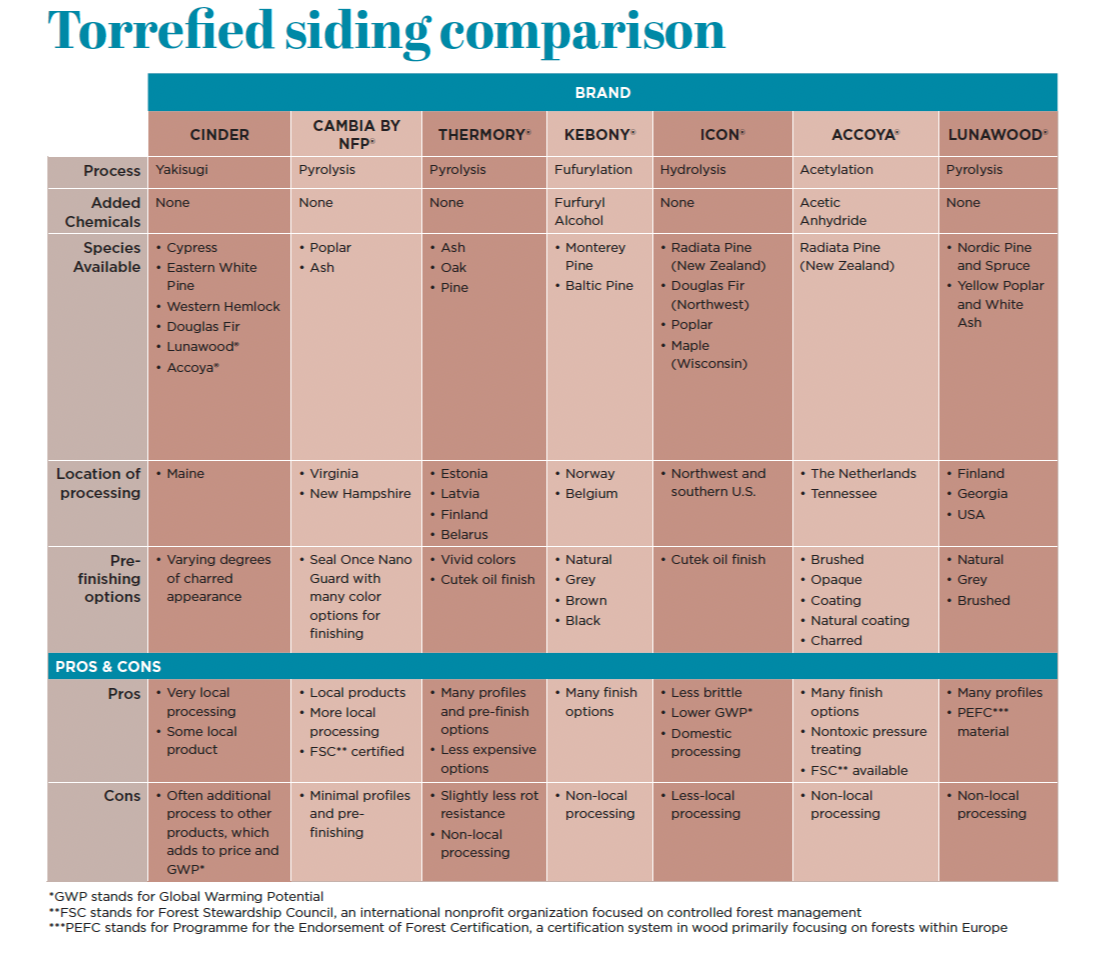
The biggest advancement in siding in recent years has come to thermally modified, or torrefied, wood (see Some like it hot). This refers to heat-treated wood that has been cooked at high temperatures in an anaerobic kiln (so it can’t ignite). This process is often called pyrolysis. The result is a wood product that resists rot and pests. Another benefit of this process is that the wood dries, darkens, and takes on a handsome appearance. From a sustainability perspective, torrified siding can be highly effective. If the wood is reasonably local (and/ or sustainably harvested), and the process is reasonably low in embodied energy, the result can be a highly durable and attractive sustainable siding. Torrified siding is not a budget option, but it can deliver good value. Brand names that are available as of this writing are Cinder (made in Hancock, Maine), Thermory®, Cambia by Northland Forest Products, Kebony, ICON®, Lunawood and Accoya®. (Accoya also uses a pressure treatment called acetylation and sells an un-torrified version that is also rot- and pest-resistant.) This is a rapidly moving market with new companies and options emerging all the time. Within this category alone, options can be staggering. Selecting torrefied siding takes a bit of research. Two major factors make these products different: species and treatment process.
Species
Torrification can be used on any number of species, and the resulting products can vary greatly with both appearance and price. For example, Thermory offers many species—from a knotty spruce that could be considered affordable, to an oak that is quite pricey but resilient enough to be used as decking. Like untreated woods, where the wood comes from and how it has been cultivated contributes to its sustainability. Soft woods from northern eastern forests will be more sustainable than Douglas fir from the northwest, Baltic larch from Finland, or Radiata pine from New Zealand.
Process
Likewise, the process is not all the same for all the products in this class. Some companies use just pyrolysis. Others use pyrolysis and steam, or even hydrolysis (a lower temperature of heat along with pressurization). This can have an effect on their embodied carbon and their performance when installed. There’s no way that we’ve covered all the options in the wide world of siding, but hopefully we’ve shared enough of the most recent changes to arm you with the knowledge you need to make good sustainable choices. Good luck and good building!
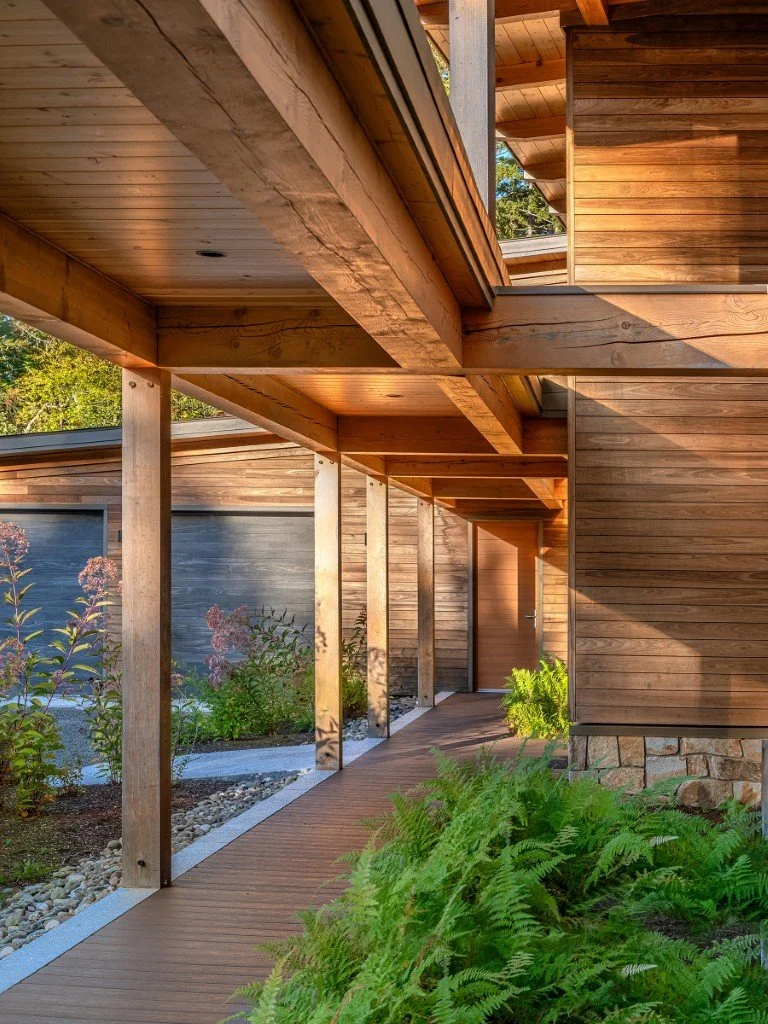
This Ellsworth home features torrefied ship lap siding (Cambia). - aged a year and a half. PHOTO: FRANCOIS GAGNE
Installation tips for TORREFIED SIDING
It sounds obvious, but it’s important to review the installation instructions and requirements for torrefied siding. Just because these products are wood doesn’t mean they can be installed in exactly the same way as other wood siding.
Account for movement
Tongue-and-groove profiles (such as nickel gap and shiplap) seem like they should nest perfectly together, snug and tight. Actually, the opposite is true. These products will expand and contract with humidity (especially across the grain) and should be installed to allow for this slight expansion by leaving a small gap between courses. It is not the same for each product, so it’s important to verify what the manufacturer recommends.
Fastening materials & method
Some torrefied woods are more brittle than others. This can play a significant role in fastening. For example, blind nailing is a method where the siding is fastened only along the top, and the groove holds the bottom. Thus, the lapping siding hides the nail heads of the siding piece below it. For some torrefied products, this is not an option due to the fragile nature of the thinner parts of the siding. This can be very important if hiding nail heads is important to your design aesthetic. (Perhaps, as designers and builders, we should become comfortable with celebrating a perfect alignment and spacing of our fasteners.)
Stainless steel is the finish of choice for siding fasteners, though some builders are accustomed to using galvanized nails. Some torrefied siding companies will not warranty an installation with anything but the nails they allow (usually excluding galvanized). This is especially important for Accoya, whose treatment includes acetylation (think of it as industrial vinegar pressure treating). This product is alkaline and will react to the zinc coating of galvanized nails and corrode and rust rapidly.
This article appeared in the Spring 2026 edition of Green & Healthy Maine HOMES. Subscribe today!
Find Maine experts that specialize in healthy, efficient homes in the Green Homes Business Directory.