
Purpose-built Passive House in Gorham, NH
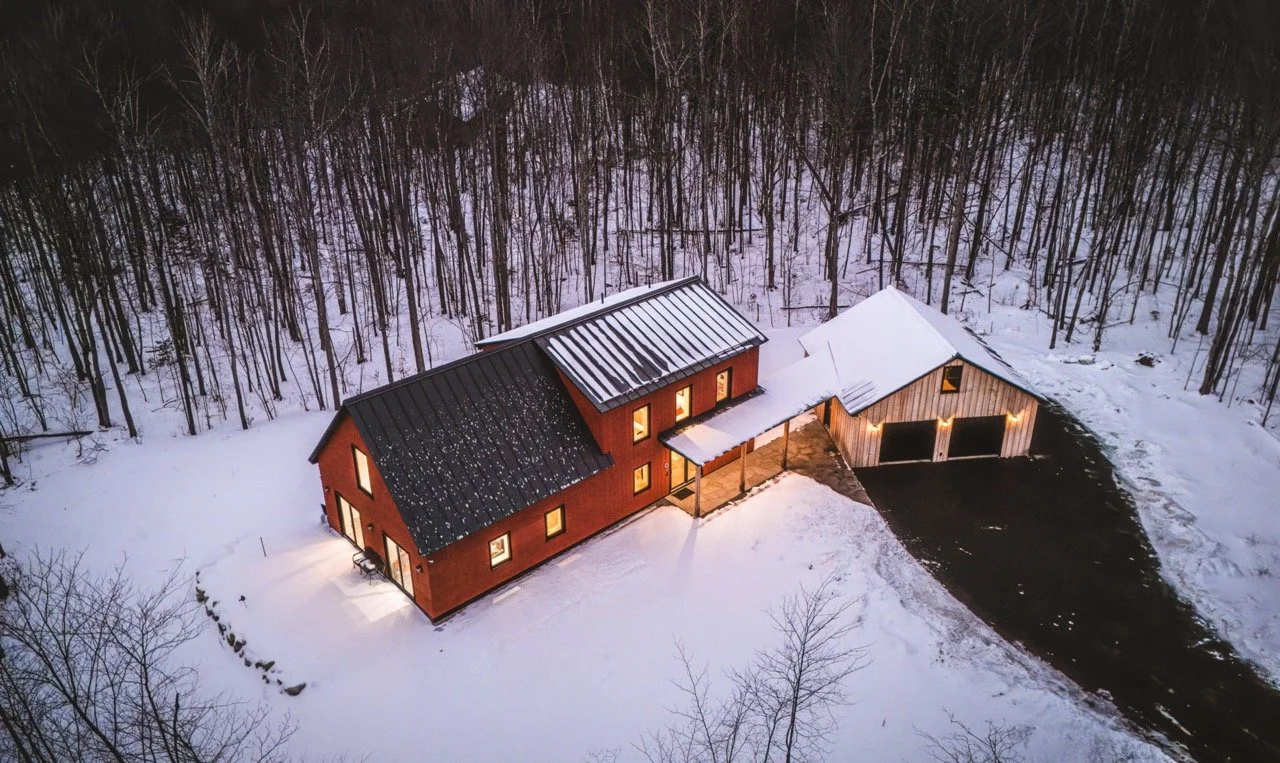
Let it snow, let it snow, let it snow: No matter how low the temperatures drop, inside this gold-standard Passive House all is easy, low-carbon living.
By June Donenfeld
Photography: Chris Bennett
WHAT DO YOU DO when you have a clear vision for a home that reflects your deepest values and desires— and want to ensure that vision is realized? If you were Rachel Rennard and Mike Bratina, who work in biotechnology and IT, respectively, you’d write a deeply thoughtful mission statement and seek out a crackerjack team that could bring it to life. That’s exactly what this couple did when they decided to move from the Boston area and make New Hampshire their new home. Both love skiing, mountain biking and hiking, so they chose the town of Gorham to be closer to the many outdoor recreational activities that the White Mountains offer. To understand their vision, the easiest way is to look at this condensed version of their mission statement:
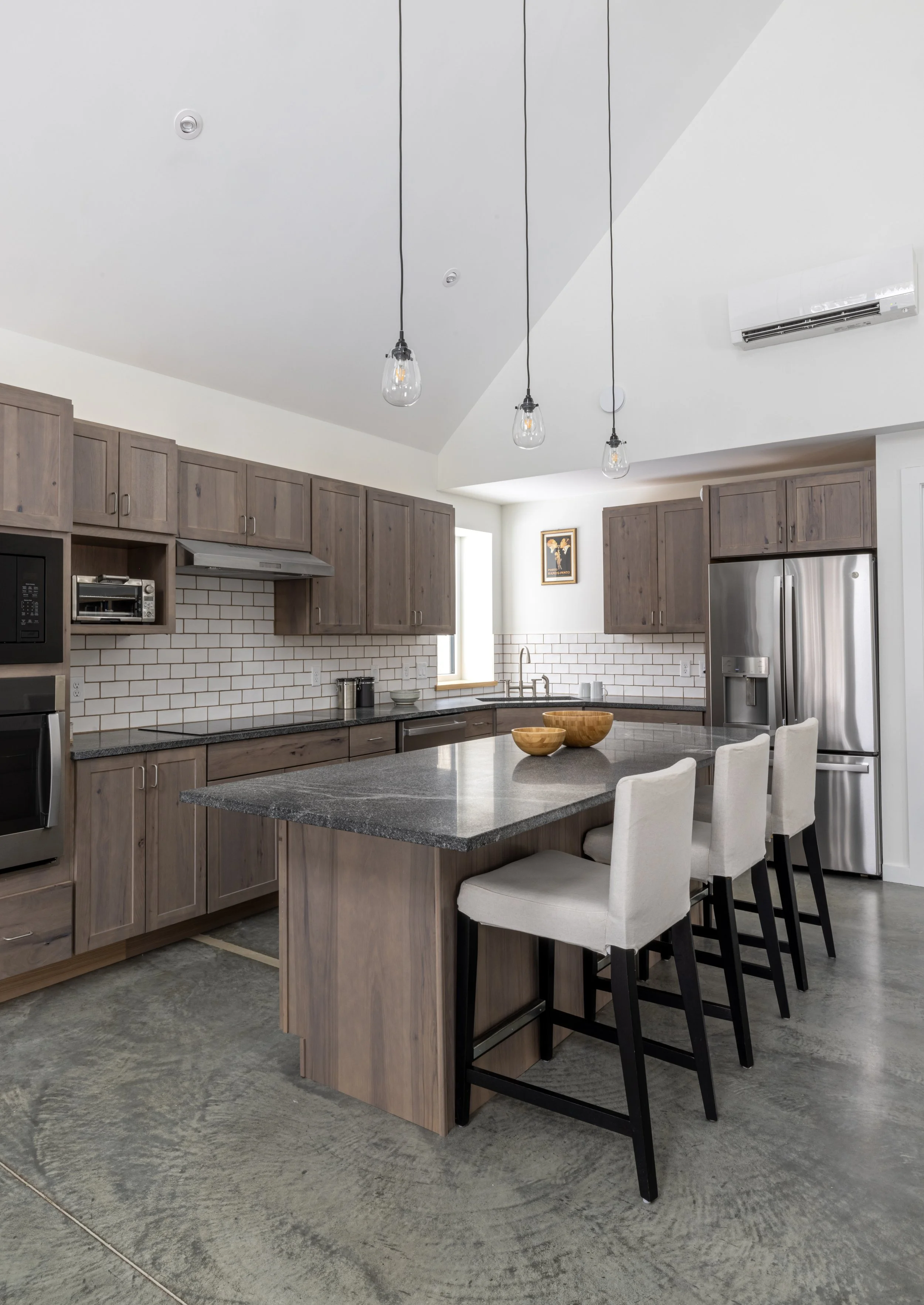
The all-electric kitchen features white-veined charcoal-gray stone counters, easy-to-clean subway tiles on the walls, Shaker-style taupe cabinetry, and a central island that accommodates three comfortable chairs with ease.
Passive House; net zero; net positive
Sustainable and environmentally friendly
Built using local resources (people and materials) when possible
Non-reliant on fossil fuels
Built to withstand changing climate
Chemical-free and high air quality
Leverage new technologies to make the house as “future proof” as possible, through systems that could work together to make it more energy efficient and healthier
Maximize Presidential Range mountain views
Modest and unassuming in style
Fit in visually in size, style, and color
Contemporary farmhouse or mountain house
Sunny and light
Connected to nature
Accommodate aging in place
Welcoming, comfortable, and built to entertain
Pet friendly
To meet their many objectives, the couple chose Maine Passive House (MPH) in Bethel for construction and Hans Breaux of PROJECT+COOP in Portland for architectural design and energy modeling; the two firms worked together on the design of the mechanical systems.
At just 8 miles from Mount Washington’s summit, which has some of the most extreme weather conditions in the country, the location called for a home that could stand up to whatever the elements threw at it—and provide a comfortable, functional healthful space to live, work and eventually age in place, no matter the season.
Building started in late fall of 2022 and finished about a year later. Carefully sited to take advantage of the stunning mountain scenery and the power of the sun’s rays, the two-story, all-electric home has simple, elegant lines and brick-red spruce siding. It connects via a covered walkway to a two-car garage clad in natural wood. Inside are an open kitchen/dining/ living area, two bedrooms, two baths, two offices and a multipurpose “flex” room.
The home brims with energy-efficient features, enabling it to earn the best Home Energy Rating System (HERS®) score in the country and New Hampshire’s first Phius certification, a stringent set of requirements for Passive House building. In the process, the home also qualified for other programs, including ENERGY STAR® for Single Family New Construction, Department of Energy’s Zero Energy Home Ready, EPA WaterSense and EPA IndoorAirplus.
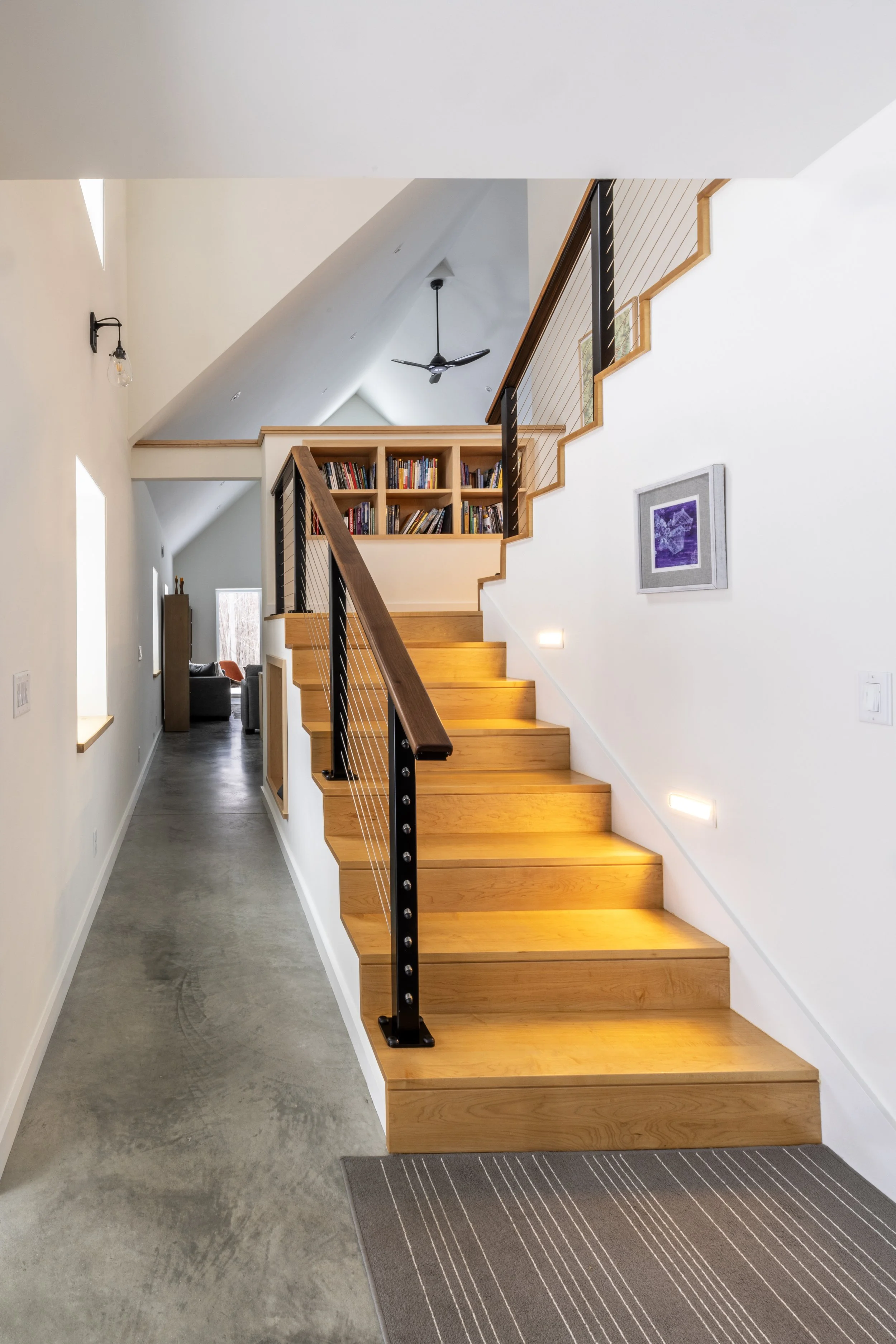
Deep, shallow wooden steps with built-in bookshelves on the landing connect the first and second floors.
The high-performance layers inside the home were key to these certifications. Breaux describes them simply: The continuous thermal boundary that goes all around and under the building is like “a winter coat with no holes in it” and consists of materials like dense cellulose insulation for the walls and roof and the under-foundation foam glass (Glavel), produced just three hours away. The weather control membrane “keeps water from the outside from coming in,” the one for vapor control “stops water vapor inside the building from wetting the inside walls, which leads to rot and mold,” and the air control layer acts “a windbreaker.”
Other high-performance features include triple-paned windows, a ducted ERV system, a heat pump water heater and two air-source heat pumps, one of which is rarely used thanks to the heavy insulation and remarkably high airtightness level of 0.37 air changes per hour (ACH) achieved through meticulous air sealing. And the direct current (DC) lighting system “not only reduced energy loads, but it also used 60% less copper, one of the most critical minerals,” says Maine Passive House CEO Katrina Belle.
In addition to energy efficiency, the homeowners “cared deeply about the impact and sourcing of the materials,” Belle says. All the lumber was grown, milled and manufactured in Maine. This includes the durable factory-finished wood siding supplied by Robbins Lumber in Searsmont and hardwood maple flooring from Maine Traditions Hardwood Flooring in Solon. To significantly reduce the use of concrete, with its high level of embodied carbon, there is a shallow slab-on-grade foundation, and the polished concrete flooring on the home’s lower level was selected for its durability and longevity. “This extreme climate and active lifestyle of the homeowners mean that it will be a hard-wearing floor,” Breaux says, “and sometimes choosing a particularly longlasting material has a higher upfront cost. Each decision has a benefit and a tradeoff, and when there are lofty environmental goals, as in this project, the magic is a balancing act between competing drivers.”
Even the driveway was subject to scrutiny. Made of pervious (or porous) asphalt, unlike standard impervious asphalt, it allows rainwater to soak into the ground. This reduces stormwater runoff, flooding and pollution; helps recharge the groundwater table; decreases the formation of standing water and ice; and naturally filters pollutants, making for cleaner creeks and rivers.
Landscaping is still a work in progress. “But we do have a design that is all native plants and incorporates pollinator and bird friendly plants, edible garden spaces, and some forageable plants such as mushrooms and berries,” Bratina says.
Judicious, forward-looking use of technology also makes this home stand out. In addition to the DC lighting system, there is a SPAN® panel, an electrical panel that enables every circuit in the house to be monitored and controlled remotely. “All of these systems are tied together into a whole-home automation platform, which allows them to work together and reduces energy costs,” Bratina says. The detailed data he collects helps the couple run their home, plan for future projects like a solar array and be notified “if there are ever hidden problems to address—which always happens in any building designed to last at least 250 years like this one,” Breaux says.
Bratina’s tracking has revealed that the actual annual energy used almost precisely matches the figure predicted by Breaux’s preconstruction computer modeling. For number lovers, the most recent figures are a Phius-modeled projection of 8,027 kilowatt hours per year vs. actual annual usage of 8,039 kilowatt hours. In other words, a hairsbreadth of difference. This outcome not only validated the computer modeling but also the construction choices made to get that energy efficiency.
This information is also being used to help more people embark on similar projects. “Another goal with this house is to use it as a way to spread the idea of energy-efficient building and getting more people to consider pursuing a Passive House,” Bratina says. For that reason, the design and Passive House teams, builder and the homeowners collaborate to share information about the house for the benefit of others, hosting open houses, making presentations and using the data to help inform improvements in future buildings.
And though it may sound as though the homeowners had bottomless pockets, they did not, and needed to make prudent financial decisions, such as delaying their solar installation.
“Through this process, we learned that building a house to Passive House standards is accessible to anyone who is building a house,” Bratina says. “The cost difference was not widely different than building a standard house and is something that can be pursued by anyone who starts down the path of building a home.”
Project Team
ARCHITECTURE PLANNING: Hans Breaux, Project CO+OP
BUILDER: Maine Passive House
MECHANICAL SYSTEMS DESIGNER: Hans Breaux, Project CO+OP, Maine Passive House
CERTIFIED PASSIVE HOUSE CONSULTANT: Hans Breaux, Project CO+OP
ENGINEERING: L&L Engineering Services, Inc.
PASSIVE HOUSE RATER: Michael Browne, Advanced Building Analysis
PHOTOGRAPHY: Chris Bennett
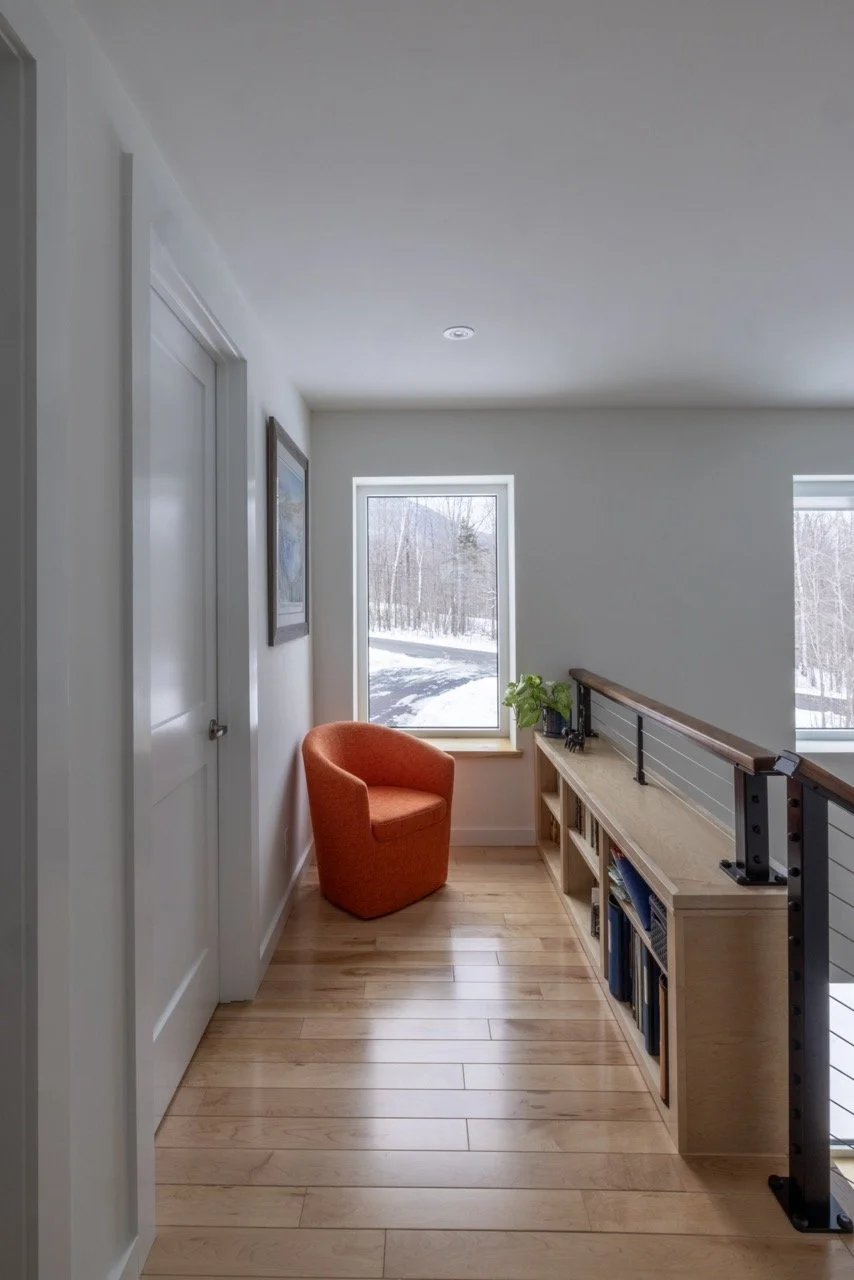
Left: Upstairs, satiny, wide-plank wooden floors, built-in bookshelves, and a comfortable pop-of-orange chair make for the coziest of reading nooks.
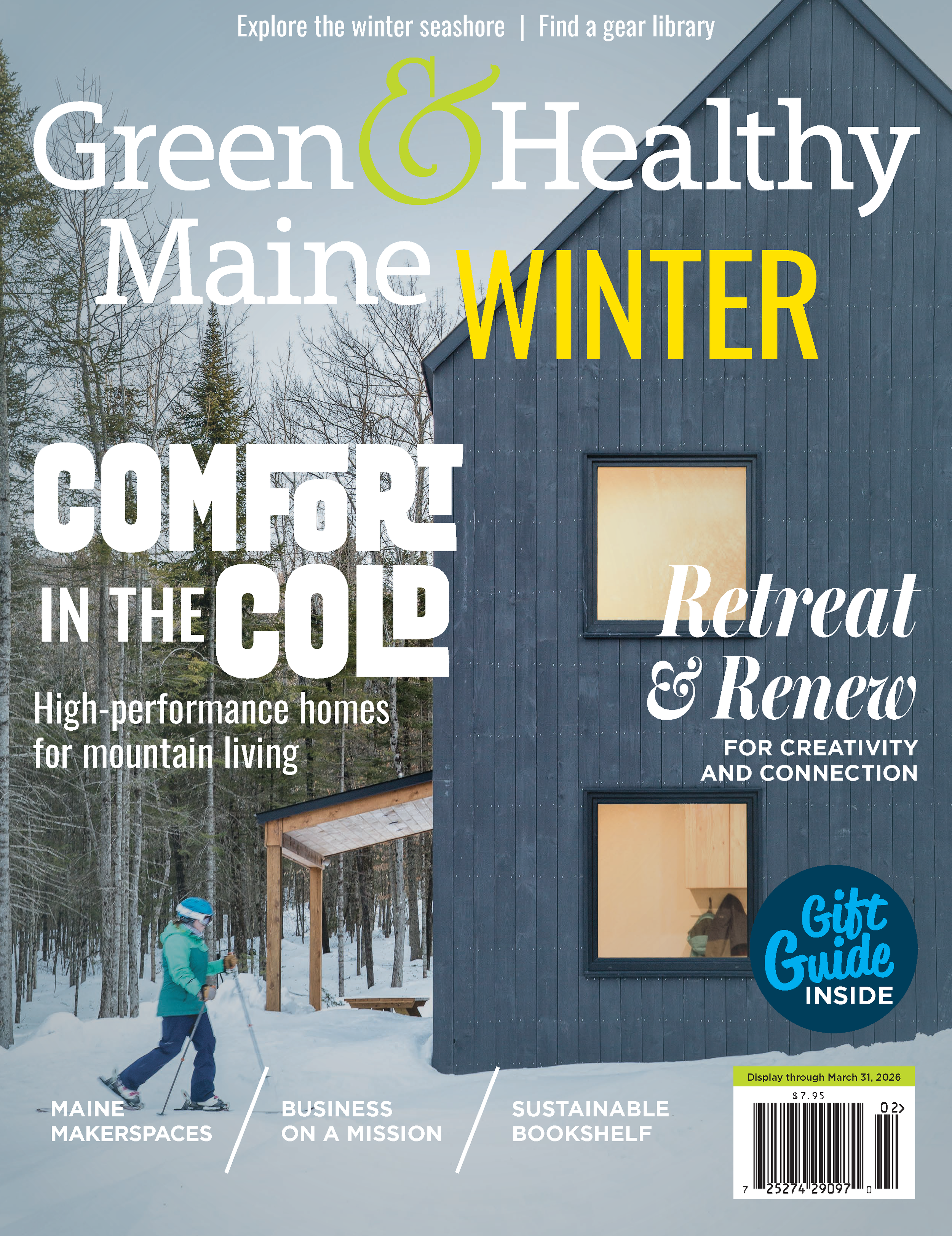
This article appeared in the Winter 2026 edition of Green & Healthy Maine. Subscribe today!
Find Maine experts that specialize in healthy, efficient homes in the Green Homes Business Directory.