
Plug-in solar comes to Maine
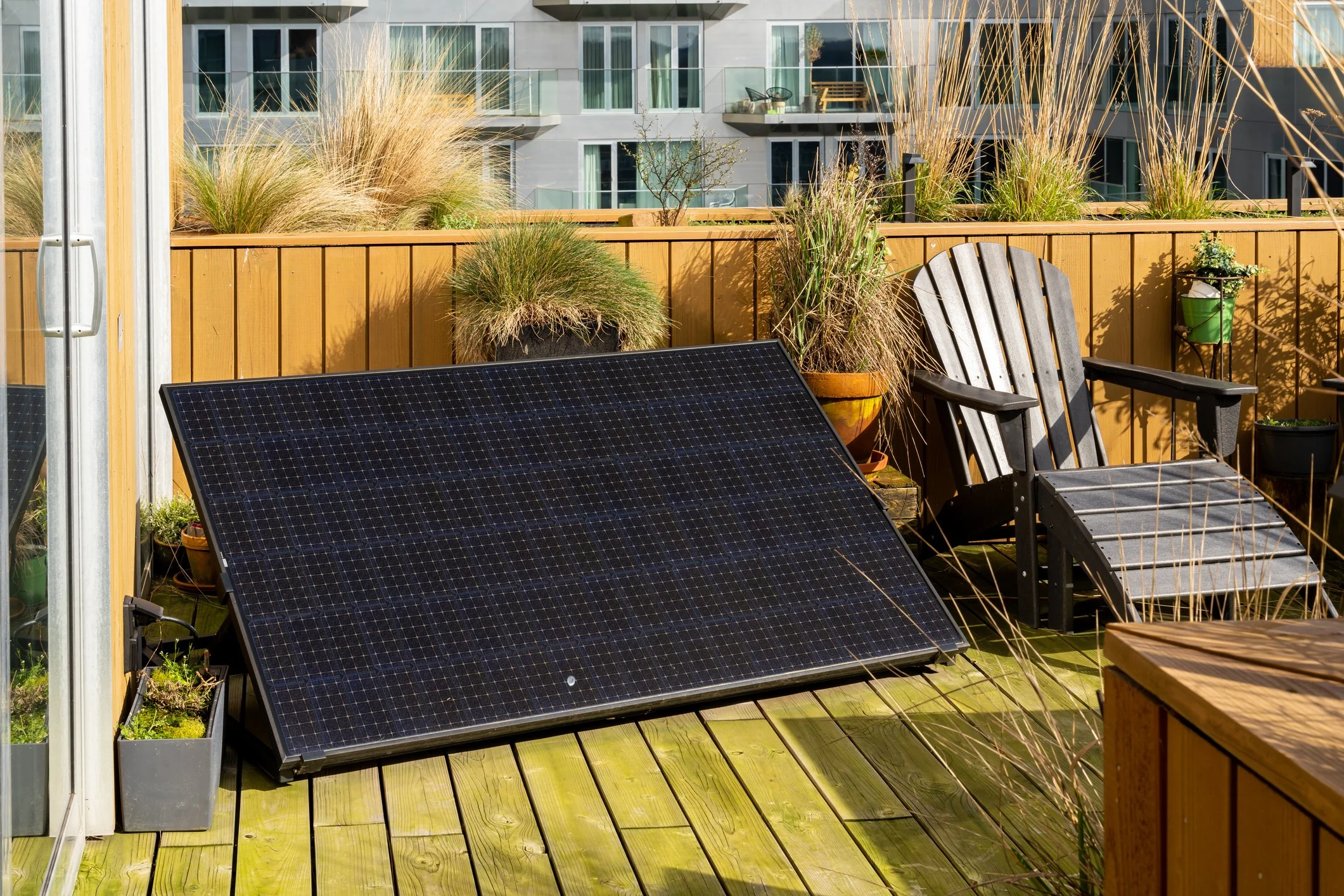
A new plug-in solar law passed in April 2026 clears the way for Maine renters, homeowners and local businesses to take advantage of small, portable solar panels to reduce their electricity bills. Here’s what you need to know about Maine’s new plug-in solar law.
WHEN WILL PLUG-IN SOLAR BE AVAILABLE TO CONSUMERS IN MAINE?
Plug-in solar systems won’t be available to consumers until updates to product safety codes and standards have been made. This is expected to happen later this year. By the fall, Mainers should be on the lookout for products advertised as being compliant with UL3700, a plug-in photovoltaic (PV) safety standard.
WHAT IS PLUG-IN SOLAR?
Plug-in solar, also called balcony solar, lets a person plug a solar panel directly into their home through a standard outdoor outlet to generate clean, renewable energy and reduce the amount of electricity they need to buy from the grid. A typical kit consists of one to four or up to six solar panels, an inverter and a plug, with the option of a battery.
The technology has taken off in Europe in recent years, especially in Germany, where there are now 1 million registered balcony units in use!
Part of the reason for this success is the appeal of these systems. Plug-in solar is small and portable and can be self-installed on a balcony railing, on a fence or in a yard. They offset only a portion of the customer’s electricity use and don’t require an interconnection agreement with the utility that is required for larger rooftop installations.
They are less expensive per watt than rooftop solar, so they lower the bar for renters and apartment dwellers and for people who can’t afford the upfront costs of installing larger solar arrays on their roofs. In Germany, a basic 800-watt (W) kit from Ikea costs around $500. In the United States, where they aren’t widely available yet, prices are higher, around $1,000 to 1,500, but are expected to come down rapidly as more states pass laws to allow them.
Plug-in solar helps save money. For the average household in Maine, a 1,200-W system—which is the maximum size permitted by Maine’s new law—could cut electricity bills by nearly 20% or $388 a year, according to the Office of the Public Advocate. And when paired with battery storage (which is already available to consumers), plug-in solar can provide a source of backup power during outages.
WHAT DOES THE NEW LAW DO?
The law prohibits utilities from making their customers get approval, pay fees or install additional equipment or controls (which are required under current regulations).
Plug-in solar is not eligible for net energy billing and is not currently available for customers who utilize community solar off-site.
The law further specifies home safety codes and standards, distinguishing between systems up to 420 W and those between 420 and 1,200 W. Here’s what you need to know:
Up to 420-W kits. Smaller units must be installed in a way that is consistent with the electrical code for other power generation sources, like backup generators. Article 705 of the National Electric Code may require, for instance, a dedicated circuit breaker in the main panel. For this reason, it is recommended to have a qualified electrician certify that the installation is done in a way that will protect your home.
420-1,200-W kits. For systems exceeding 420 W, the law requires that a licensed electrician install the equipment and use a dedicated circuit with only a single outlet. This is a protective measure given the diversity of electrical wiring across Maine’s housing stock and aims to ensure home wiring is configured to effectively mitigate back-feeding risks. Customers with systems exceeding 420 W must also notify their utility within 30 days of installation.
As a related safety provision, the law also requires systems of any size to have inverters that are configured to shut off after 0.2 seconds if power from the grid is disrupted and to protect utility line workers in the event of an outage. This can also reduce the risk of touch shock at home if a plug becomes partially unplugged.
Electrical and product safety standards will be specified in UL3700, issued by UL Solutions, an independent product certification laboratory. The new safety standards are expected to be finalized in the coming months, and Mainers should ensure certification of product compliance before purchasing.
Utah was the first state to legalize plug-in solar, followed by Maine, and more than 20 states are considering similar bills this year.
A collaboration of Maine nonprofit groups worked together to advocate for the passage of this bill, including A Climate to Thrive, Maine Climate Action Now, and the Natural Resources Council of Maine (NRCM), among others.
This article was adopted from a piece written by Rebecca Schultz, a NRCM senior advocate for climate and clean energy.
Want to learn more about plug-in solar? Check out our webinar from the Home + Energy Chats series on the subject.

This article appeared in the Spring 2026 edition of Green & Healthy Maine HOMES. Subscribe today!
Find Maine experts that specialize in healthy, efficient homes in the Green Homes Business Directory.