
Bringing down the house
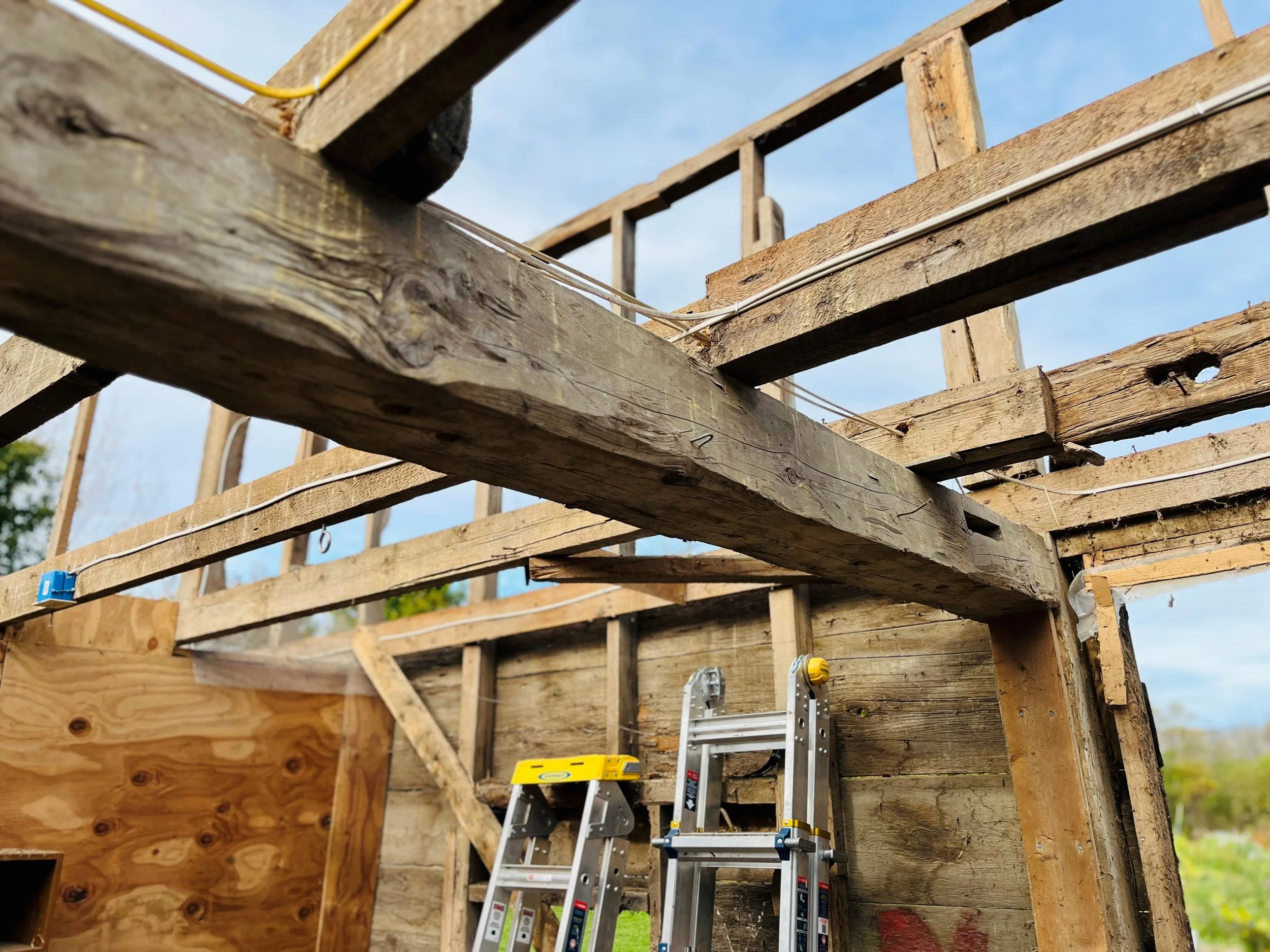
Antique hand-hewn beams and other salvageable building elements await final dismantling at this beautiful building on the Midcoast.
How deconstruction helps grow maine’s circular economy
By June Donenfeld
Photos by Danny Salomon unless otherwise noted.
In a 1939 Peaks Island directory printed when street addresses were still transitioning from names to the modern-if-mundane numbers we see today, you can see monikers that range from the idyllic (Diamond View) to the bucolic (The Glen) to the droll (Hatetoleaveit).
But down the road from me on the Midcoast, there’s a sadder-than-sad abandoned house that I’ve dubbed The Lost Cause, where you can still see scalloped cladding on the fallen eaves, faded red clapboards, tumbledown chimneys and insulation poking out like feathers from an old pillow. While the rotted exterior wood may be past the point of no return, inside there are doubtless elements that could still be put to good use. And though few are as far gone as this once-stately home, there are legions of old buildings all over Maine that are still being destined for traditional demolition (think wrecking balls and mountains of landfill-bound debris).
Danny Salomon wants to change all that. When he comes upon one of these old buildings, he doesn’t see an eyesore—he sees opportunity. Salomon is founder and principal of the state’s first dedicated deconstruction business, Second Story Builders in Union. He and his Midcoast-based team carefully dismantle buildings that have outlived their useful lives, reclaim materials and sell or give them fresh life in new building projects.
Deconstruction dramatically reduces the amount of debris that might otherwise go to landfill—no small thing in a state where about half the of that space is taken up by construction and demolition debris (CDD). For Second Story Builders, the timing couldn’t be better: New laws have been requiring yearly increases in the recycling rates for all solid waste processing facilities, such as the 50% for CDD beginning in 2026. This is an enormous jump from the 1.1% reported by Maine’s Department of Environmental Protection in 2023.
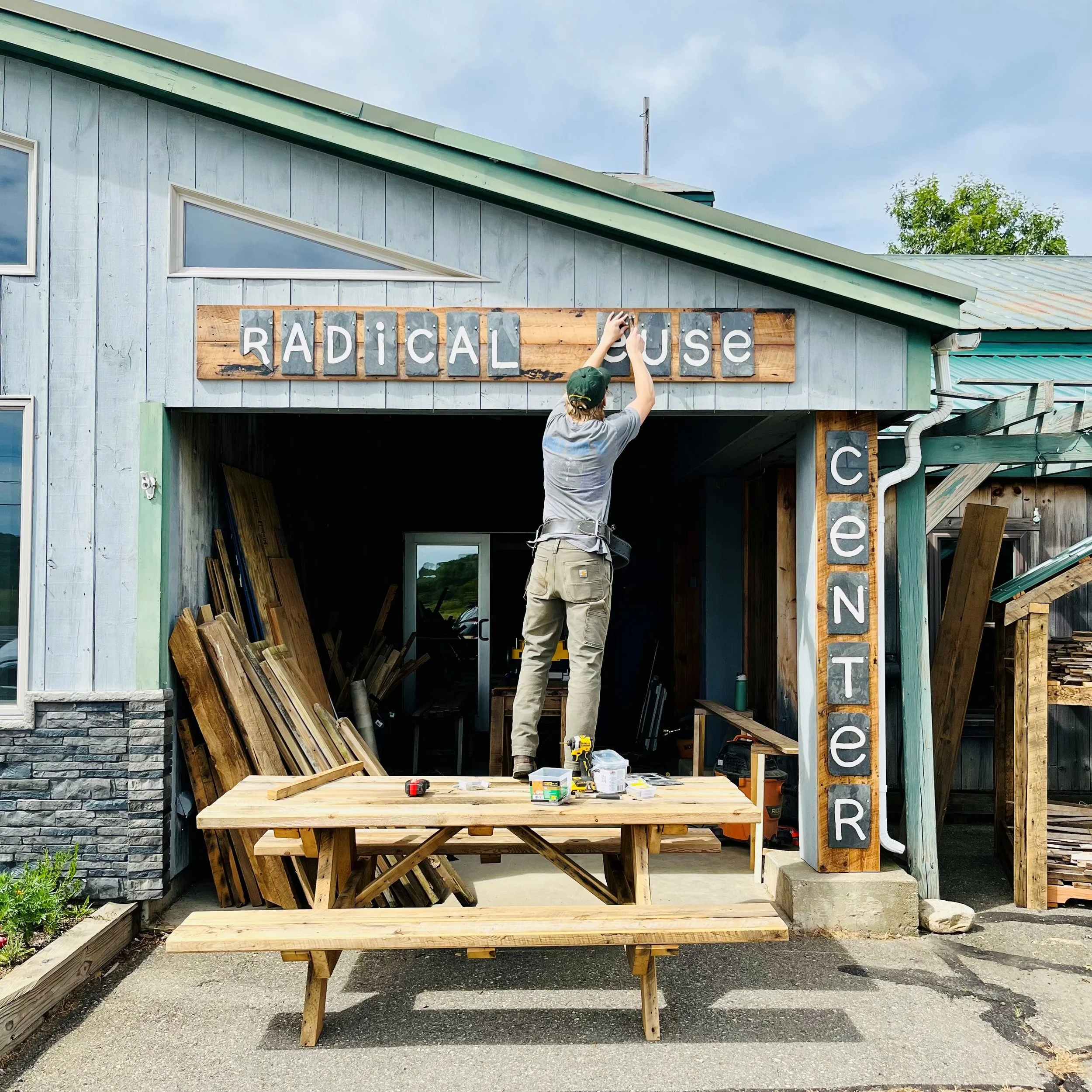
Gavin Sivigny installs reclaimed slate shingle signage at the Second Story Builders’ Radical Reuse Center in Union, which sells high-quality salvaged materials to the public, meeting local needs and supporting the Maine circular economy.
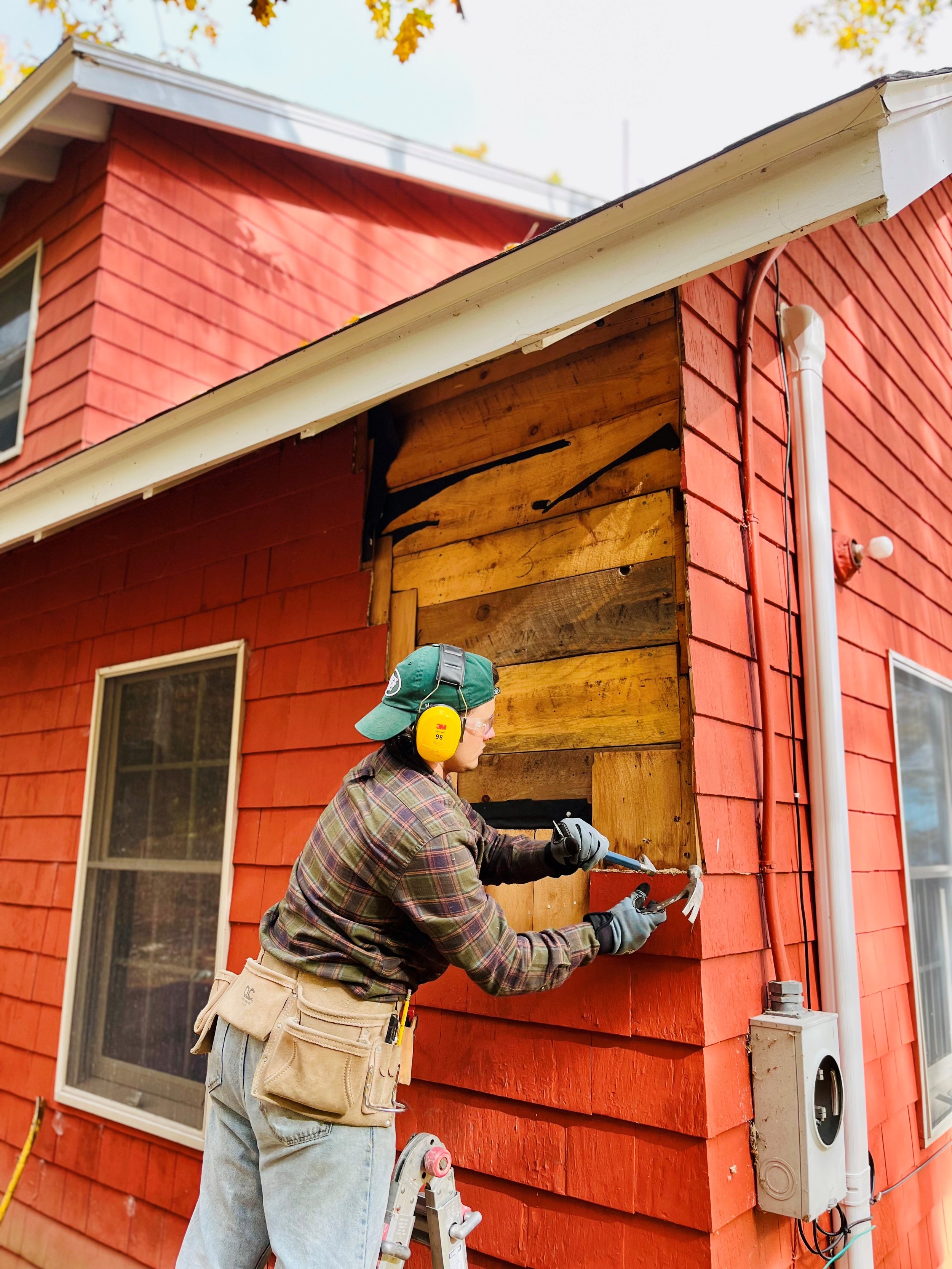
Rebecca Troast painstakingly salvages siding at a barn deconstruction project in Rockland.
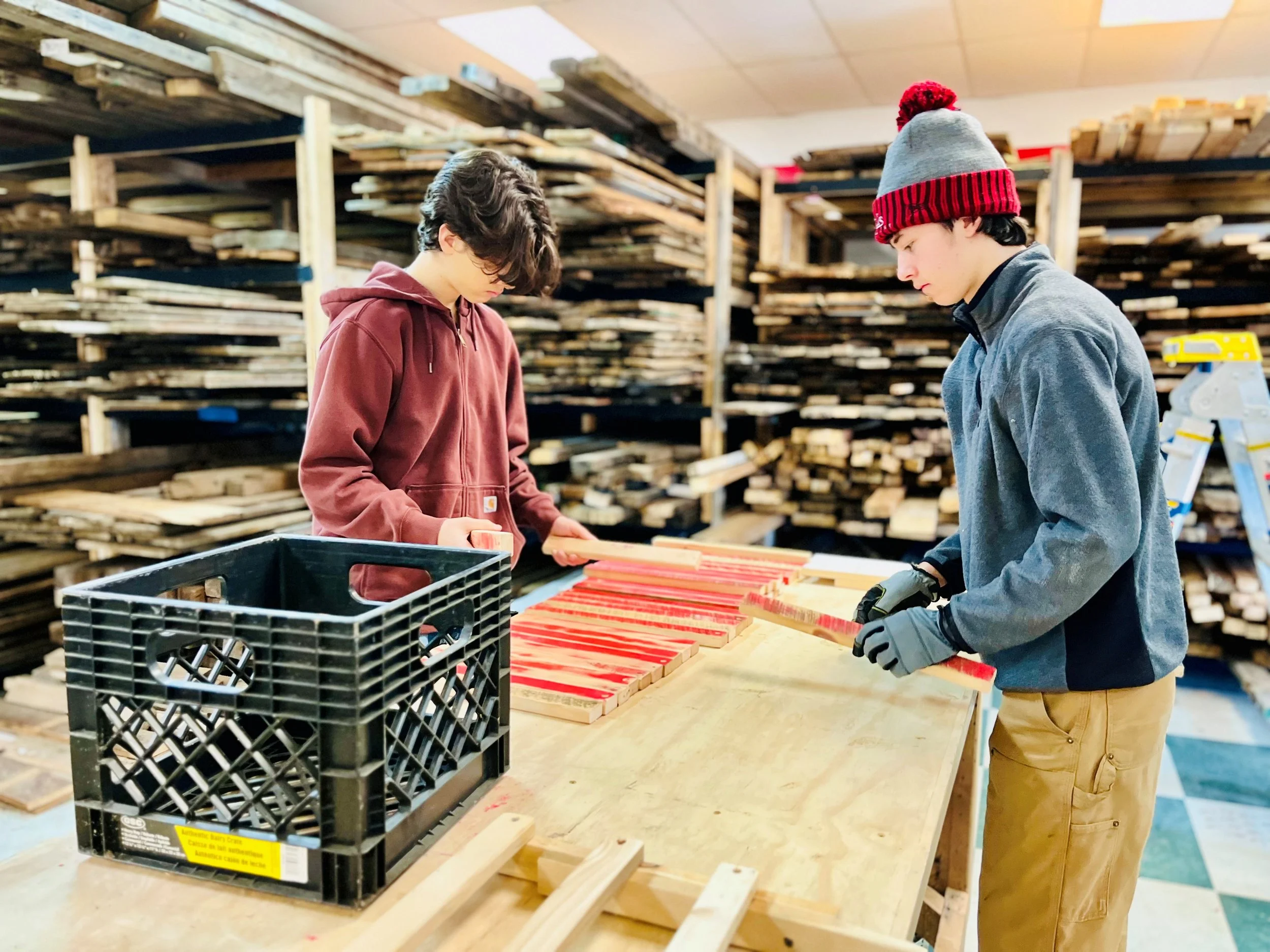
Jude Mora (left) and Finn Kornfield (right) methodically process off-cuts for a furniture-making project as participants in a paid high school internship program through Second Story Builders at the Radical Reuse Center.
While Second Story Builders is playing a vital role in helping Maine reach its CDD recycling goal, Salomon’s vision for deconstruction goes well beyond its environmental benefits. Second Story Builders takes a wholistic approach to deconstruction, using it as a way to educate, collaborate, strengthen Maine’s economy, protect the environment, develop the workforce, build community and even preserve history.
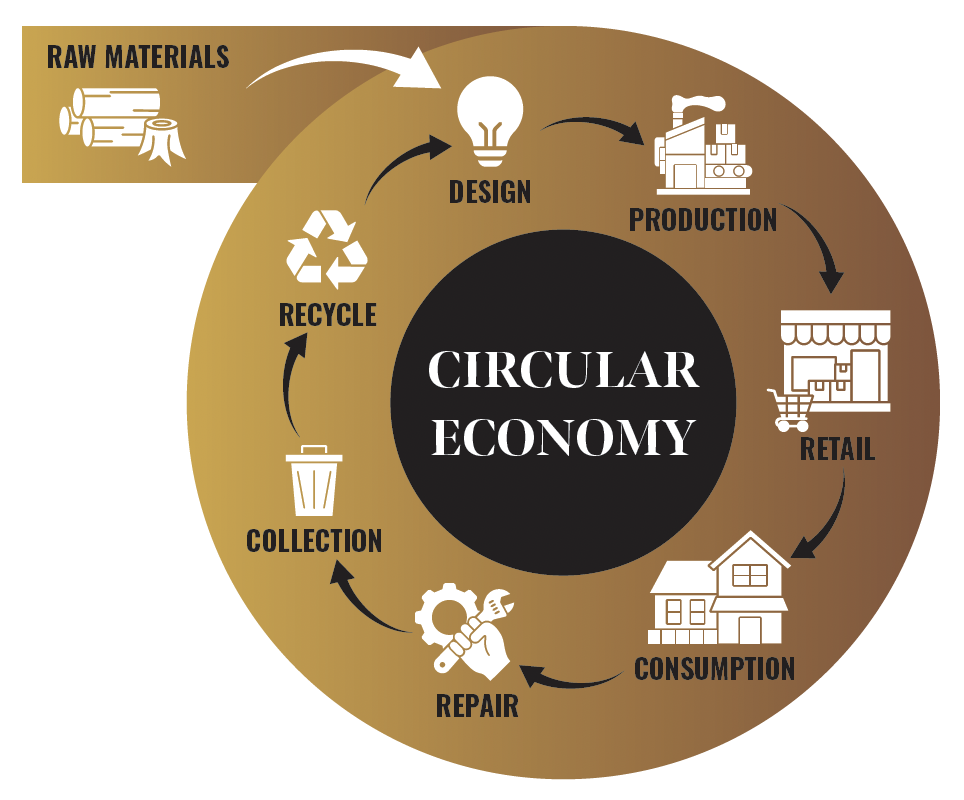
Salomon sees deconstruction as a way to advance the circular built environment, a regenerative system that minimizes waste and maximizes resource efficiency across the entire lifecycle of buildings and infrastructure. This is starkly different from the typical linear approach to material use (make, use, discard) that is business as usual in construction today.
Salomon also sees deconstruction as a way to train youth—and other community members—in sustainable building methods that emphasize reuse and hands-on learning.
This aspect of Second Story’s mission was sparked by Salomon’s earlier experiences in the design and building world, starting with his time at Cornell University, where he earned his professional architecture degree. With a focus on computer-based design, the program existed in a cloistered environment divorced from the physical process of building itself. For Salomon, his program lacked two essential ingredients: real-world experience and collaboration.
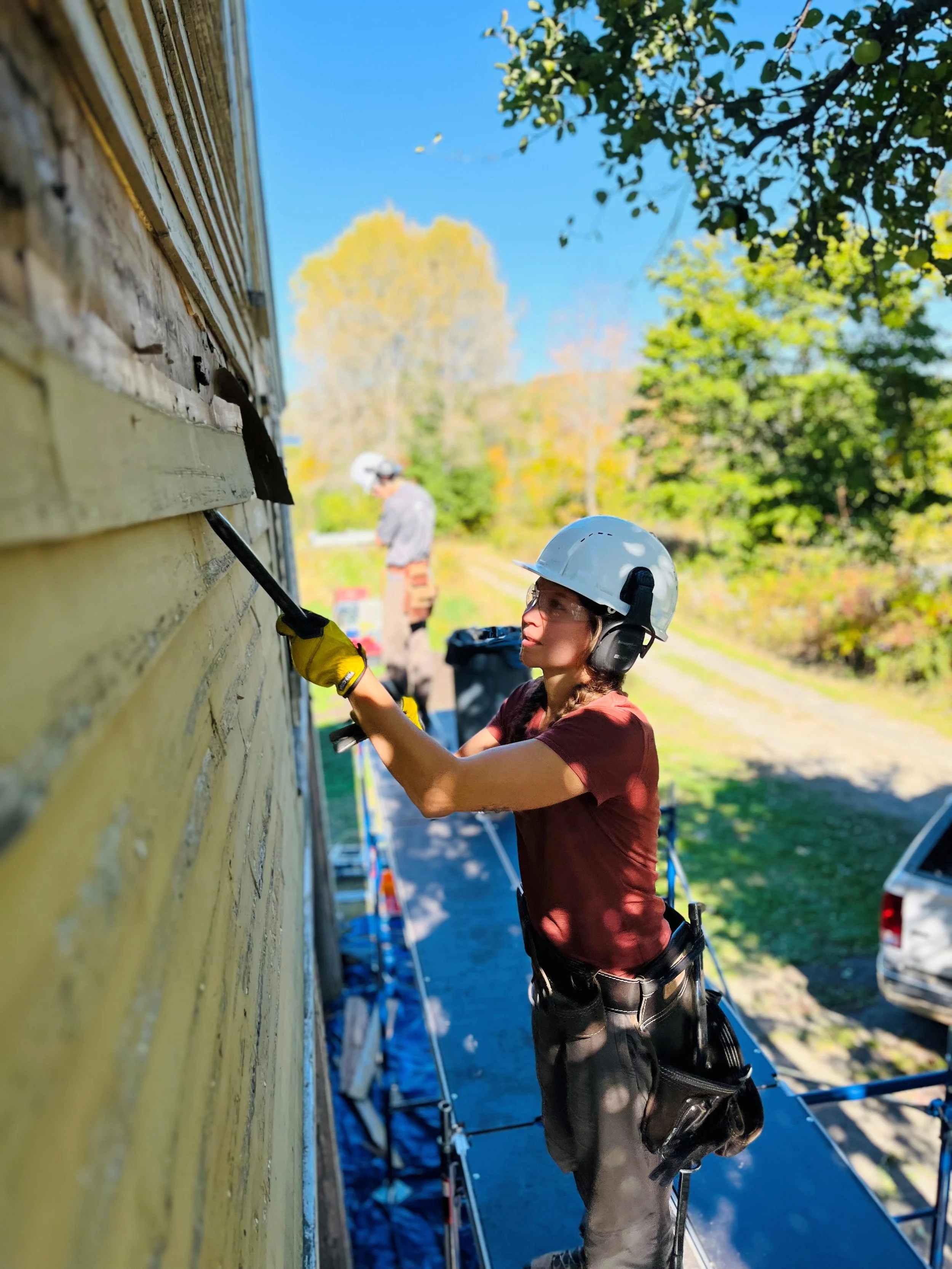
Amanda Schelling removes siding at a barn deconstruction project in Rockland.
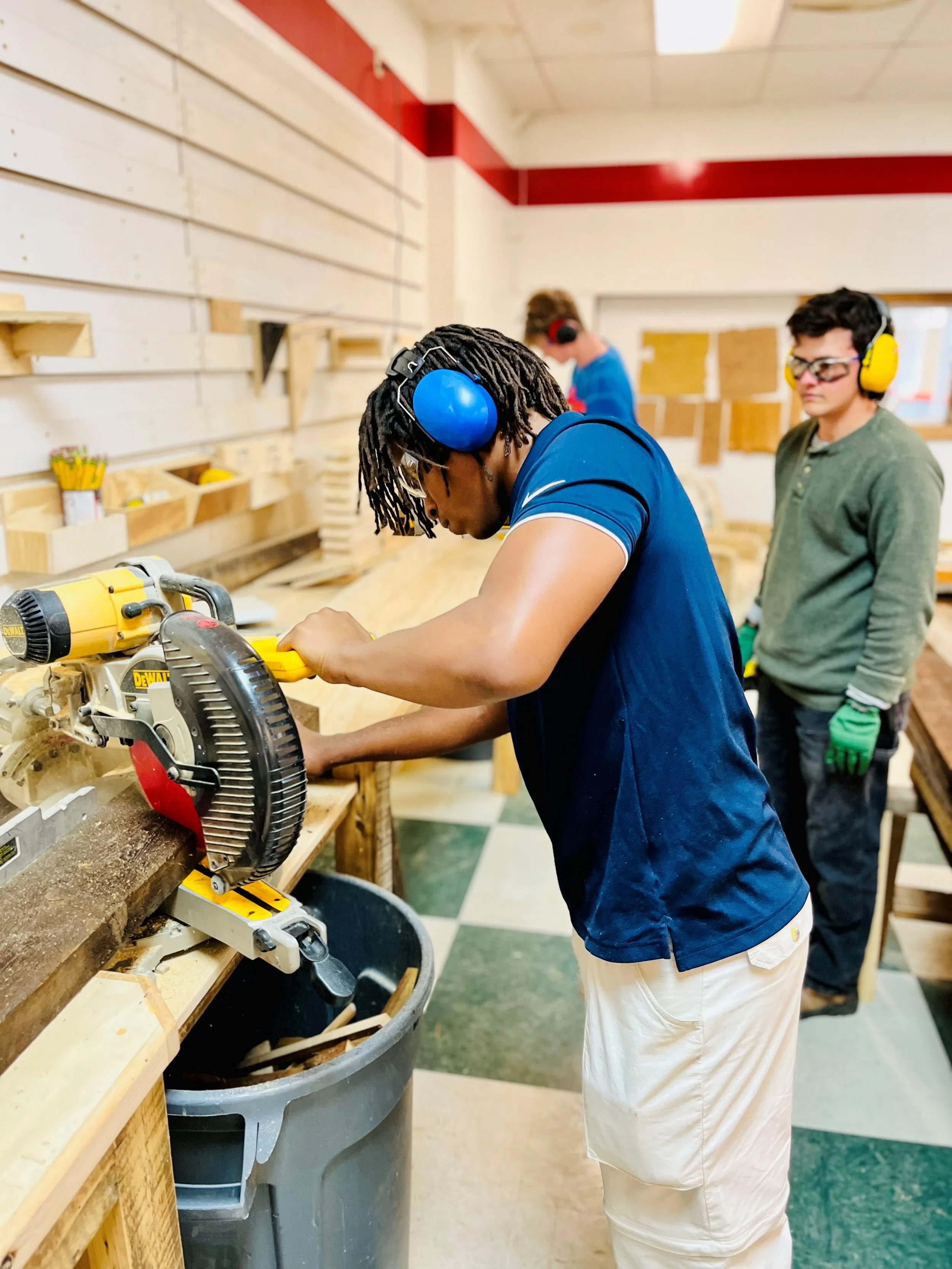
Wesley Mayhorn repurposes old rafters to make nature-watching benches as part of a collaboration with Camden Hills Regional High School.
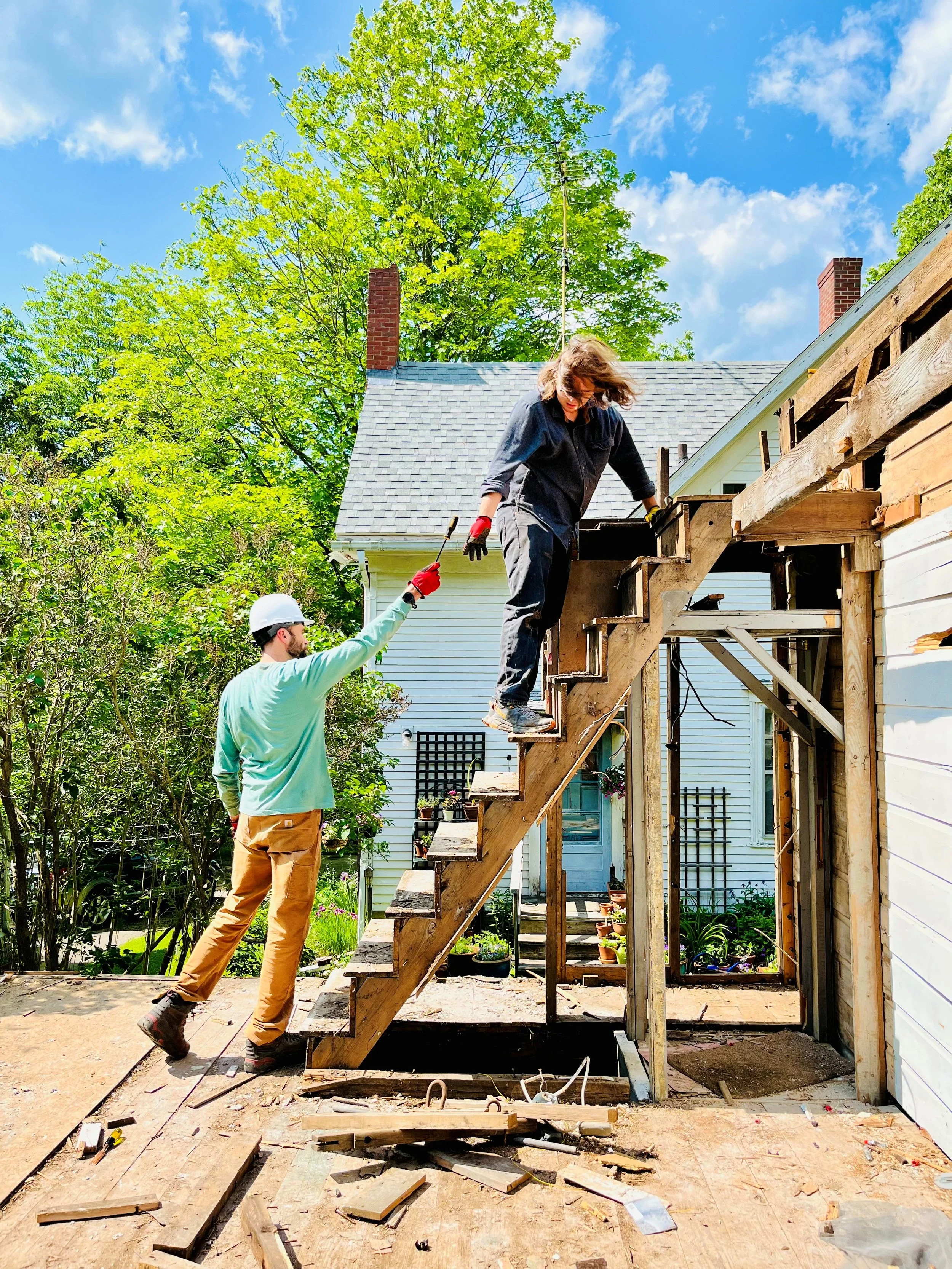
Evan Waters (left) and Pippin Friden (right) working together to deconstruct the historic Federal-style, ca. 1800 Ephraim Barrett House on Chestnut Street in Camden.
“The pedagogical approach felt very detached from reality,” he says, “and I eventually concluded, years later, that architects really ought to know how to build, and that this aspect of an architect’s training—which doesn’t exist within the formal, institutionalized curriculum of today—is an essential antidote to the problem.”
Since then, thanks to his own independent research and formative experiences postgraduation, Salomon has been committed to becoming a design-build educator. “I think everyone can benefit—not just architects—from this educational model,” he says.
That commitment only deepened when Salomon was at Camden Hills Regional High School from 2020 to 2023 as director of The Hatchery, an apprenticeship program centered on “radical reuse,” a principle that prioritizes the reuse, repair and repurposing of materials and products. The program “started with really humble beginnings,” Salomon says, but proved wildly popular with the students.
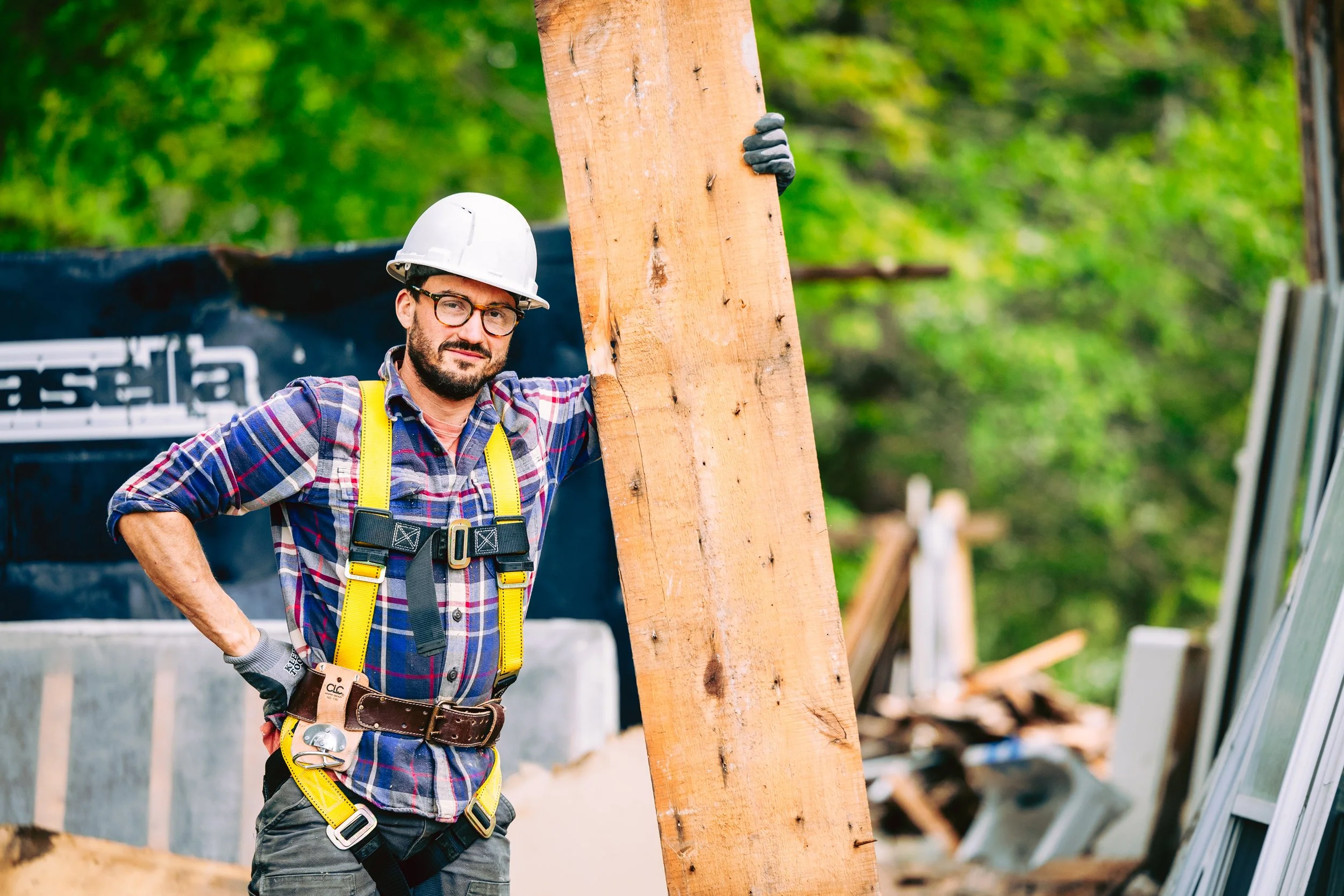
Danny Salomon of Second Story Builders PHOTO: LANDON GEIS
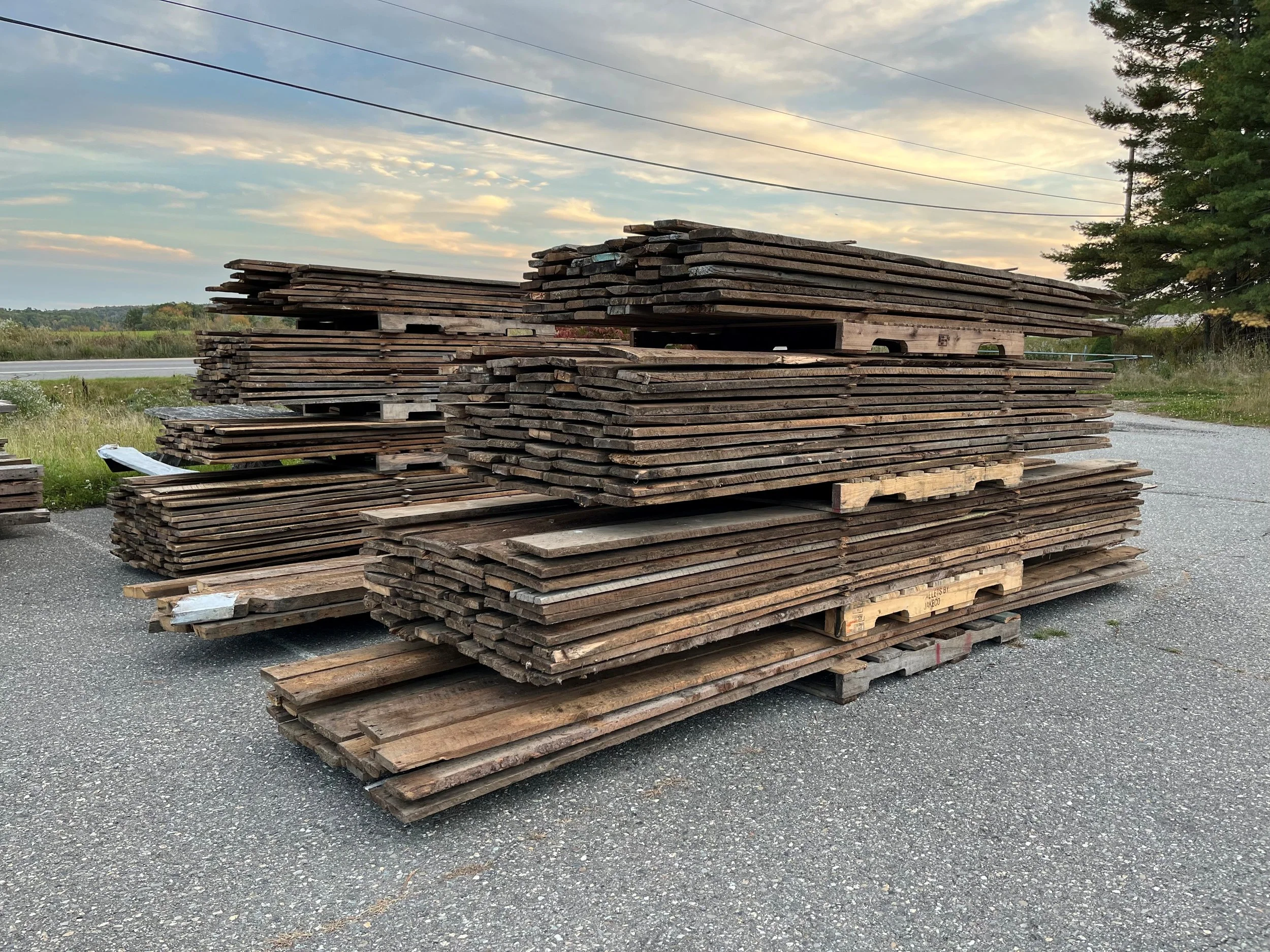
Salvaged lumber, sorted, stacked and ready to be given new life in other construction projects.
When word got out in the community, about its work, the Hatchery started getting requests to deconstruct and repurpose wood, as they did with lumber from the storm-destroyed Camden boardwalk that they used to build half a dozen public picnic tables that went back to the community.
Projects like this led to the eventual dismantling of a traditional house in Camden slated for demolishment, whose owner asked Salomon if he’d be interested in taking away the good floorboards. Salomon’s response? “What about the whole house?”
This became the first full-house deconstruction project for Second Story Builders, which Salomon founded at the end of 2025. Thanks to his design and construction skills—and a small army of student helpers—the reclaimed wood found new life in the interior of the Villager Cafe in Camden as tables, wainscotting and a coffee bar. Since then, the enterprise has been off and running, and to ensure they’ll be here for the long haul, one of their goals is to create a market for deconstructed materials to avoid any supply-and demand bottlenecks. To that end, they now offer a design-build service and operate a retail store in Union selling a range of salvaged materials.
Luckily for Maine, Second Story Builders is not a lone voice in the wilderness. Megan Mansfield-Pryor, a sustainability specialist at Maine’s Department of Environmental Protection (DEP), founded The Maine Deconstruction Network in 2024 when she was serving as a policy advisor the Governor’s Office of Policy Innovation and the Future. This informal professional network has been meeting monthly since 2025 and is dedicated to realizing the economic opportunities and environmental benefits of deconstruction. Members include representatives from nonprofits, trade and building associations, the business community and state government, such as passivhausMAINE, Greater Portland Landmarks, the City of South Portland and more. Regardless of sector, all see the wisdom in moving from a linear building economy to a circular one and want to do their part through education and training, workforce development or community engagement.
The group is currently largely in learning mode at these meetings, engaging with experts who help members “understand the barriers, the benefits and what factors contribute to deconstruction becoming a thriving economic activity in areas where it is a common practice,” Mansfield-Pryor says. A list of past guest speakers reads like a who’s who in the field of deconstruction. Hailing from across the nation, they include Shawn Wood from the U.S. Green Building Council; Dave Bennink, founder of Reuse Consulting/Building Deconstruction Network; and Kathi Mirza, who runs the Massachusetts DEP Deconstruction Workgroup, “the inspiration for our network,” Mansfield-Pryor says.
REclaimed retail therapy
These (mostly) Maine companies sell reclaimed wood, structural elements, decorative items, fixtures and hardware, furniture made from reclaimed wood, new materials left over from construction projects, and more. (And to allay any concerns you might have about using lumber from old buildings: Old-growth wood has denser growth rings than fast-grown modern timber and more heartwood, the tree’s decay-resistant center. It also has dimensional stability as it has been in place for a long time and has already expanded and contracted many times, making it much less likely to warp, twist or split in new installations.)
RADICAL REUSE CENTER • Union • secondstorybuilders.com
LAST SHEAF BUILDING MATERIALS EXCHANGE • Lisbon • lastsheaf.org
BARN BOARDS AND MORE • Gardiner • barnboardsandmore.com
LONGLEAF LUMBER • Berwick • longleaflumber.com
RENAISSANCE TIMBER • Cumberland • renaissancetimberllc.com
ROUSSEAU RECLAIMED LUMBER & FLOORING • Windham • rousseaureclaimed.com
LOVEJOY RUSTIC FURNITURE • Oakland • lovejoyfurniture.com
OLD HOUSE PARTS CO • Kennebunk • oldhouseparts.com
RUSTIQUE LLC • Kennebunk • antiquewoodcreations.com

This article appeared in the Spring 2026 edition of Green & Healthy Maine HOMES. Subscribe today!
Find Maine experts that specialize in healthy, efficient homes in the Green Homes Business Directory.