Affordable by design
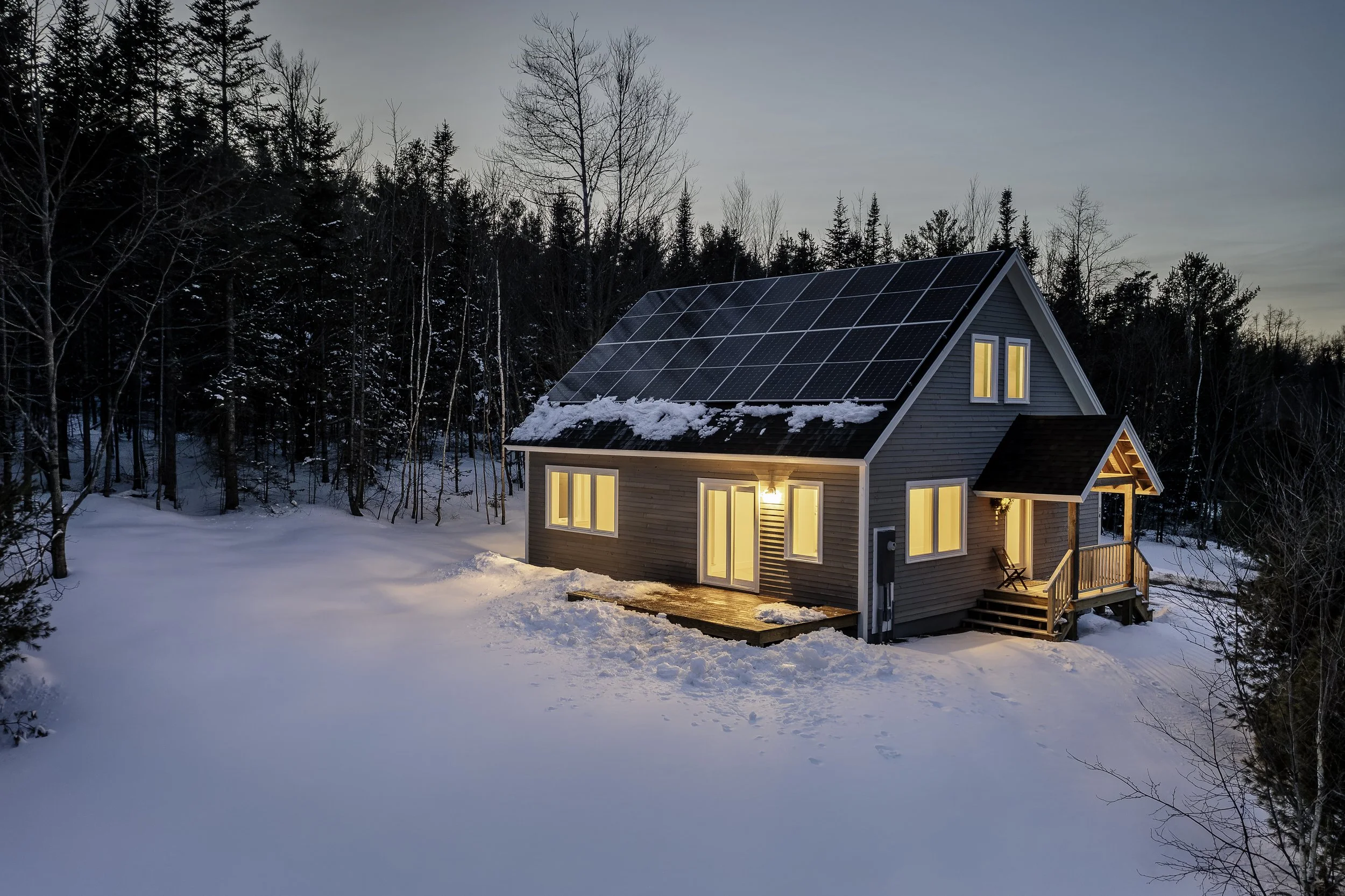
Harsh weather will be no match for this new high-performance house by Zero Energy Homes, whose tight construction, heat pumps and triple-pane windows keep extreme temperatures and the elements at bay. PHOTO: SARAH SZWAJKOS PHOTOGRAPHY
maine company makes high-performance homes more attainable
By June Donenfeld
WHEN CAMILLE SEO purchased a small plot of land in Gorham in the fall of 2019, she envisioned building a home there “as locally and sustainably as possible in order to support my community.”
Her vision was clear, yet the way forward was not. “The most challenging part of my path to homeownership was finding a company to build with who shared my vision and values for a future home that was within my budget,” Seo says. “It has always been important to me to build a home with locally sourced materials selected with sustainability in mind and that the final home have a lowered carbon footprint.”
Cost was also an obstacle for Seo, a longtime staff member at a Maine nonprofit that supports individuals with intellectual or developmental disabilities and their families. “Net-zero homes built sustainably often come with a large price tag,” she says, “which is unfortunately out of my reach as a single-income household working in the nonprofit world.”
But serendipity (some might call it fate) had other ideas.
Seo was on the mailing list of BrightBuilt Homes, a Portland architectural firm specializing in modular, high-performance homes. One day, she received a questionnaire from BrightBuilt that finally set the wheels turning. The questionnaire was designed to gauge prospective homebuyers’ priorities, she says, “and to streamline the building process, with the end goal of creating more affordable homes that also maintained the same focus on sustainability.”
In 2024, Seo went to the Green Home + Energy Show in South Portland (organized by Green & Healthy Maine). She made a beeline for the BrightBuilt booth to follow up about the questionnaire, where she was encouraged to speak with Caroline Pryor, founder and president of Zero Energy Homes, who was also there.
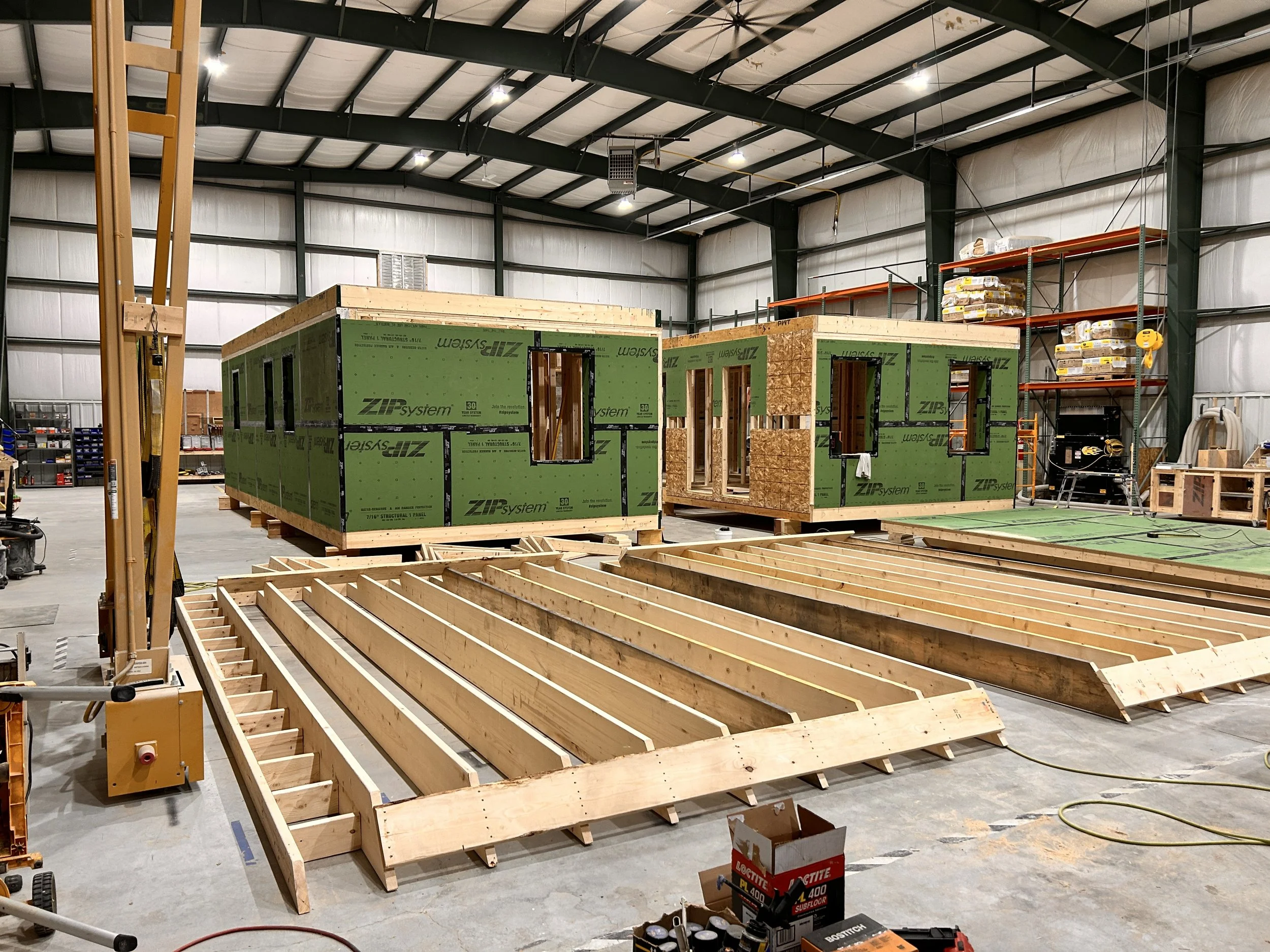
At Zero Energy Home’s modern manufacturing facility in Wiscasset, components are assembled with precision, speeding production and ensuring both materials and workers are protected from poor weather conditions. PHOTO: ZERO ENERGY HOMES
“The rest is history!” Seo says.
That happy “history” is the story of Seo’s road to homeownership, which was paved by Zero Energy Homes (ZEH), a mission driven company based in the Hancock County town of Mount Desert but working across Maine. The startup is well on its way to providing affordable, high-quality, high-performance, healthy and sustainable homes for a broad swath of Mainers, including those whose lower incomes can make this kind of home out of financial reach.
ZEH has developed an innovative model for how homes are designed, sourced, financed, produced and delivered, all part of their three-pronged mission to address housing, climate/sustainability, and rural economic development, Pryor says. To that third end, their homes are also built largely with Maine and regional building materials, supporting both state and local economies and the people who work in them.
With the negative ripple effects of Maine’s acute housing shortage growing ever stronger, ZEH’s work couldn’t come at a more important time. Over the coming five years, the state is projected to need 80,000 new homes. “Providing more and different housing options requires many approaches,” Pryor says. “From high-rise apartments to duplexes, single-family homes, community and congregate living, tiny homes, portable yurts—Maine needs it all.”
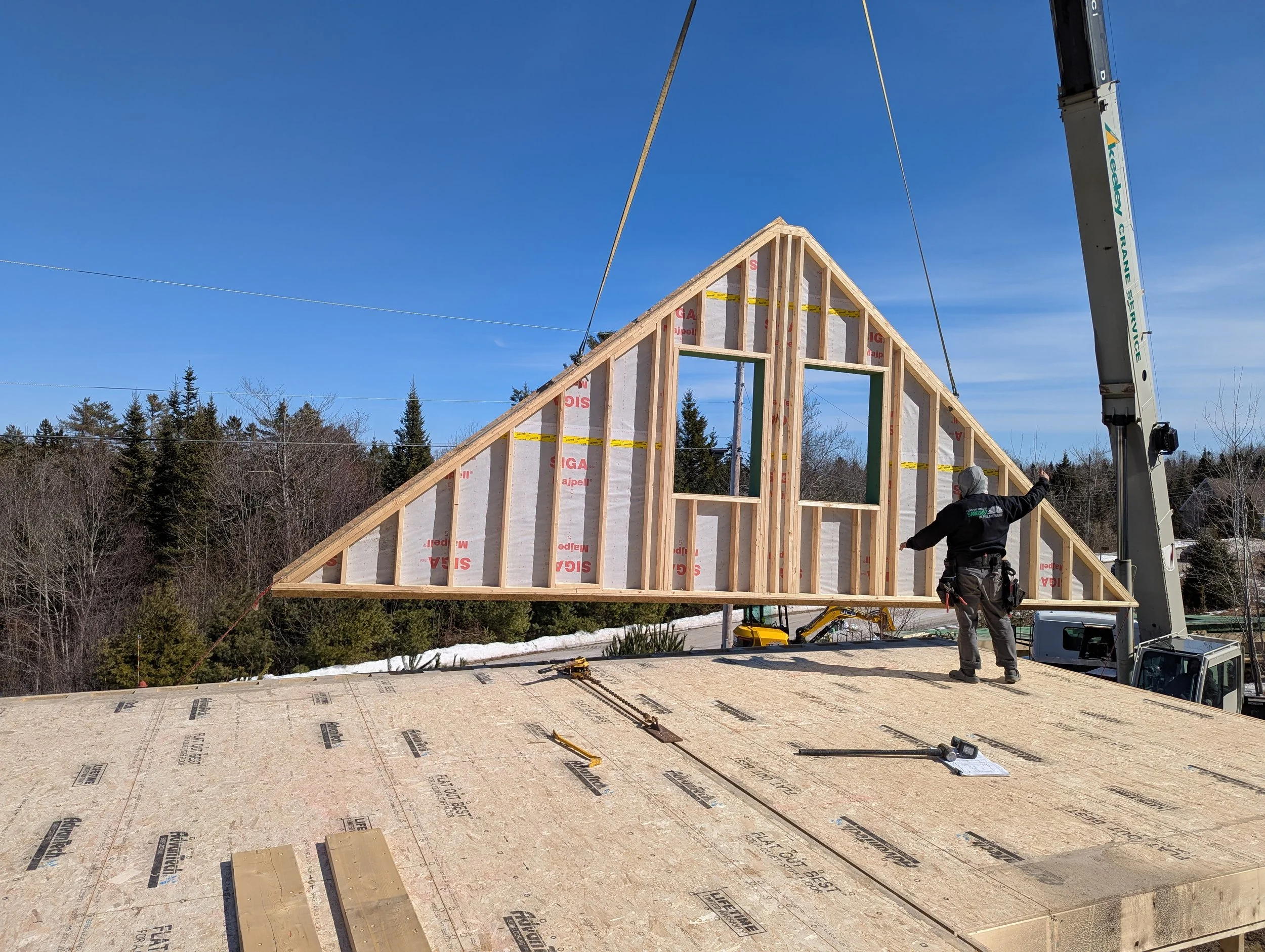
A presassembled gable is lowered onto Zero Energy Home's demonstration home in Searsport, on what is called “set day.” PHOTO: ZERO ENERGY HOMES
ZEH’s creative approach was more than two decades in the making. The genesis of the young company lies in the aftermath of the catastrophic 2005 Hurricane Katrina in the Southeast. “The U.S. had the opportunity to rebuild more than a million housing units that could have been solar-powered, energy efficient and made with a healthier supply chain of building materials,” Pryor says. The Washington, D.C. Healthy Building Network, a research and advocacy nonprofit focused on healthier building materials, proposed a business plan to accomplish exactly that, but the 2007–2008 financial crisis put it on indefinite hold.
The plan was simply dormant, though, and found a second life in Maine, thanks to Pryor’s colleague and friend Jim Vallette, CEO of Material Research L3C in Southwest Harbor, a supply chain research company that collaborates with the Healthy Building Network. “Jim and I co-founded Material Research in 2019, and that’s where the Maine version of Zero Energy Homes started,” Pryor says. “Jim gave me the original business plan and encouraged me to see if I could give it traction here in Maine. And Material Research also helped [us] develop a more sustainable, Maine-based supply chain.”
By its very nature, ZEH has a lot of moving parts, and Pryor faced some daunting challenges to get it up and running, from access to working capital to fallout from COVID-19. “We started the R&D right before lockdown,” she says, “and needed to build relationships and find expertise through online meetings.”
But persistence, patience and flexibility paid off: ZEH was set up as an LLC in 2023 and moved to an opt-in cooperative ownership structure in 2025. “I chose this form of ownership because it places governance in the people who work at the company and know it best, not out-of-state venture funds,” Pryor said. “Future profits will be shared by employees and investors, and it’s a way to keep community and Maine-based investments circulating in our local and regional economies.”
Cooperatives foster resilience, stability, loyalty, education and skill-building, too. “The cooperative model works when employee-owners are engaged and take responsibility for democratic governance. In practice, that means an additional layer of work for those employees that opt in to ownership,” Pryor says. “It requires a commitment to learning, access to training and information, and good communication all around.”
ZEH also promotes what it calls an “Innovation mindset: every person, every job,” which strengthens the organization itself and can have a far-reaching impact. Inspired by the University of Maine’s work in teaching this approach, Pryor asks questions such as, “How are employees inspired to think about how their job can be done with better results?”
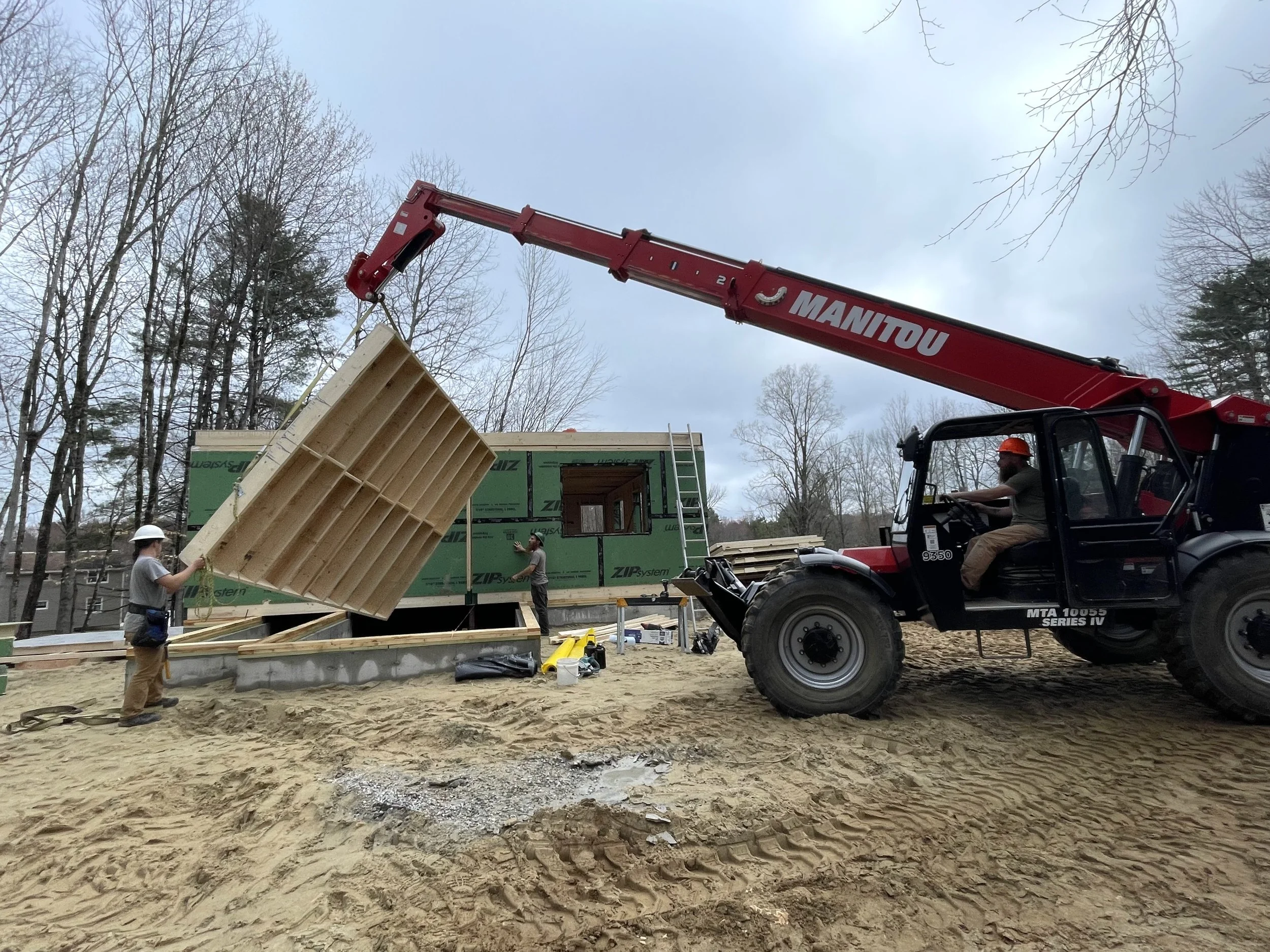
A floor is lowered carefully onto the foundation of Seo's home-to-be in Gorham, to be topped by room modules waiting their turn for on-site assembly. PHOTO: ZERO ENERGY HOMES
The answers can be transformative. “If given the opportunity, an entry-level carpenter can positively affect the company’s bottom line by suggesting better or safer processes and then share in that upside,” Pryor says. “A purchasing clerk can add strategic and financial value by developing sustainable and resilient supply chains.”
To build its homes, ZEH currently uses off-site panelization and is preparing to embark on modular manufacturing as well. Both panelized and modular construction methods take place in factories with the finished components shipped to the build site. Panelized building produces flat-packed structural components (like walls and floors) that are assembled into a structural shell on-site, where the rest of the home is finished. Modular construction involves building entire three-dimensional rooms or sections before assembling and finishing them on-site.
Each method has pros and cons, but both ensure precision production and protect the materials and workers from the elements. “We are working on our modular license now, and once that is in place, we will offer both panelization and modular,” Pryor says. “Some sites cannot support a large truck and crane that’s required to transport and set the modular components, so we plan to continue to offer a panelized option.”
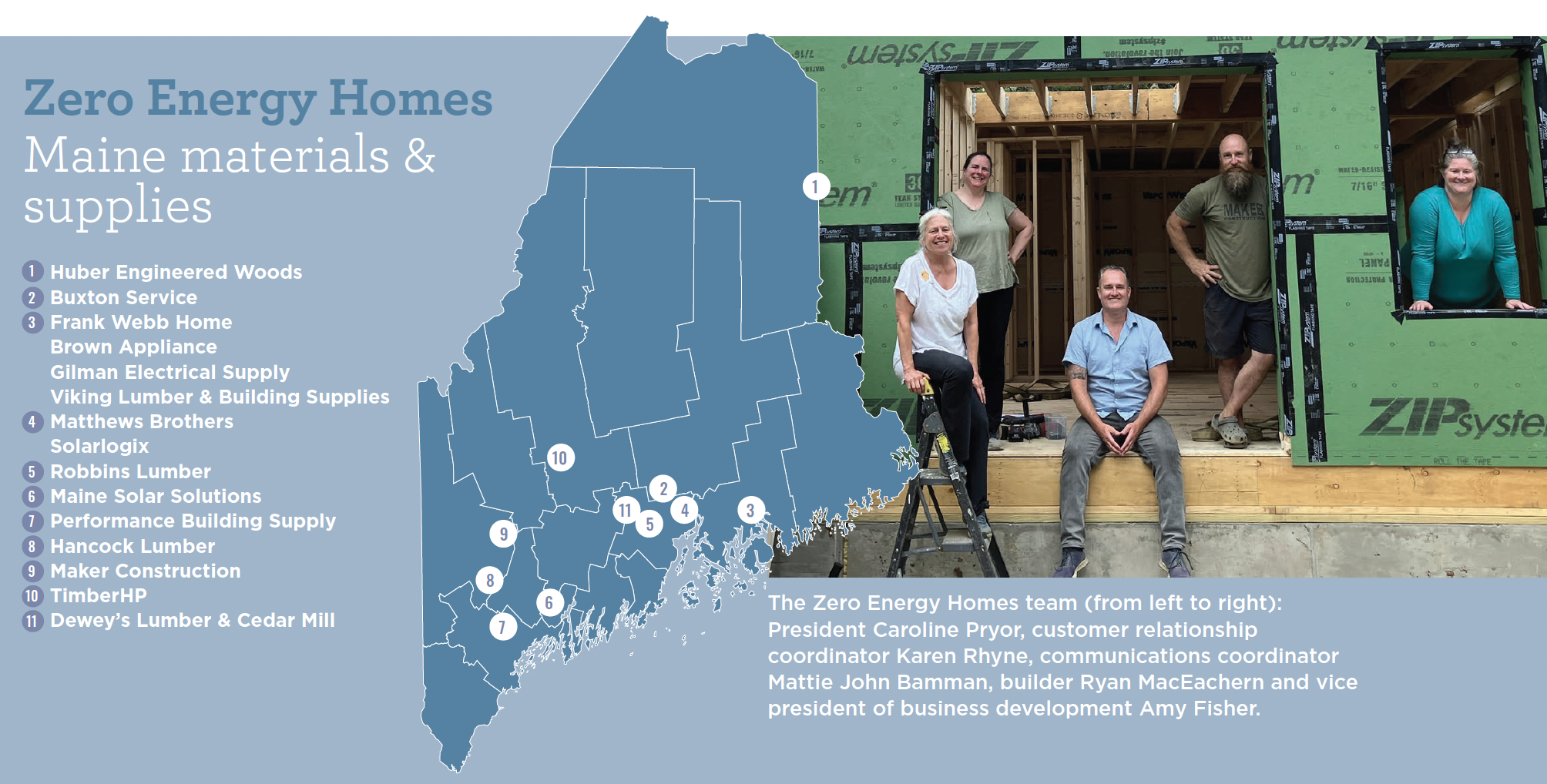
ZEH offers standard one-, two- and three-bedroom designs within three basic home footprints of approximately 600, 900 and 1,300 square feet, all of which can be customized to a certain degree, though the smallest design has not yet been finalized.
ZEH can either complete the homes down to the last detail or allow their customers to do some of the finish work, such as painting or flooring, knowing that “sweat equity is an important part of how some households get to affordability,” Pryor notes.
The all-electric homes enjoy net-zero energy use, which means they produce more electricity than they consume, resulting in electrical bills that reflect just the cost of connecting to the grid, or roughly $30 monthly. High-performance features include insulated foundations and 10-inch-thick walls; solar arrays from Maine Solar Solutions, wood-fiber insulation from TimberHP and triple-pane windows from Mathews Brothers Co. (all three Maine companies); and heat pumps, heat pump water heaters, LED lighting and energy recovery ventilators (ERVs) to draw fresh air inside and expel stale air outside. The homes also come with well-insulated second stories for future finishing if the homeowner wants to expand their living space, which lowers upfront construction costs.
Eighty percent of the building materials come from Maine or close by, including dimensional lumber, sheathing, exterior cladding, flooring, trim, wood-fiber insulation, windows, cedar decking, hemlock posts and windows.
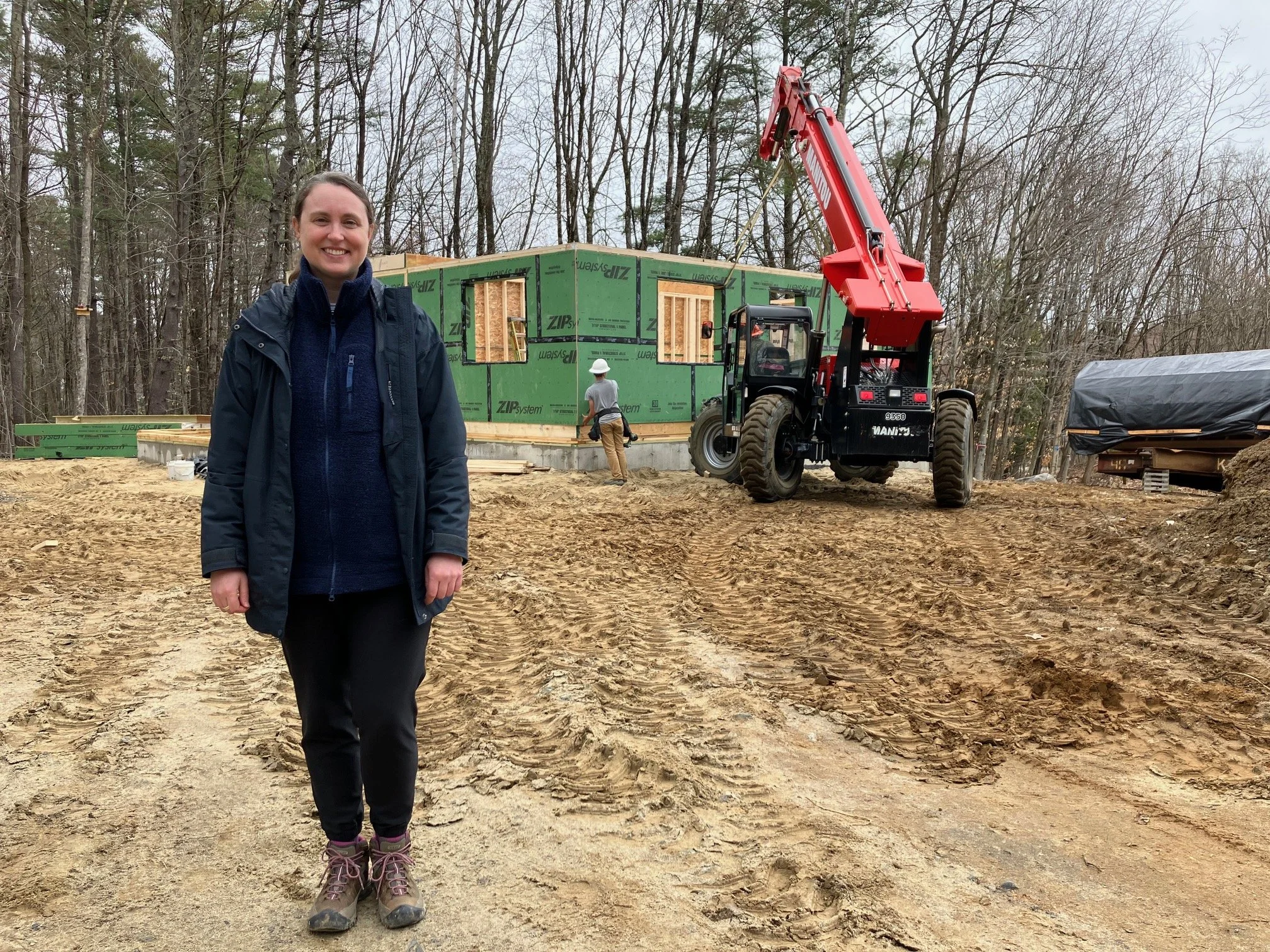
Camille Seo witnesses her dream of homeownership become a reality. PHOTO: JOHN ERSEK, GORHAM TIMES
To ensure affordability, ZEH takes a flexible approach to financing the homes they build. Some of their innovations include using Maine Seed Capital Tax Credits from FAME (Finance Authority of Maine); working with various for-profit, CDFI and nonprofit lenders; and encouraging charitable donations to NGO housing partners. They also collaborate with foundations on impact investments and program-related investments, which differ from grants and allow a foundation to invest more deeply in mission-based work.
With five homes already completed or in progress, ZEH plans to increase production to 50 annually over the next five years.
Camille Seo is the happy owner of one of those five homes, and though her house isn’t quite finished as of this writing, I invited her to envision what will be.
“Having my own home will be a massive accomplishment for me,” she says. “I joke I have been saving my whole life for this moment and am extremely proud to put down roots in a home that I will own. While my day-to-day life will still be the same, the fact that I’m doing everything in my own home compared to a rented space adds a thrill to every activity! I am most looking forward to breaking in the kitchen by trying out new recipes and whipping up old favorites. Once the cooking is complete, I’ll be carving out a cozy spot to tackle my endless to-be-read booklist with my Maine Coon cat nearby. In the evening, I envision opening up the windows to let in a cool breeze and listening to the sound of the birds saying hello to the newest resident in their neighborhood.”
A few financial terms:
IMPACT INVESTING is a hybrid of philanthropy and traditional finance. It allocates capital to businesses, organization and funds in order to generate a measurable, positive social or environmental impact as well as a competitive financial return.
PROGRAM-RELATED INVESTMENTS (PRIs) are mission-driven financial investments made by foundations to support charitable causes. Unlike grants, they are expected to be repaid and function like loans or equity investments, enabling foundations to reuse funds while putting social impact first, rather than financial return.
A COMMUNITY DEVELOPMENT FINANCIAL INSTITUTION (CDFI) is a mission-driven financial organization certified by the U.S. Department of the Treasury’s CDFI Fund. It provides affordable credit, capital and financial services to underserved populations, small businesses, and low- to moderate-income communities.
THE MAINE ENTREPRENEURIAL RESOURCE CORPS (MERC) is a grant and consulting program of the Maine Technology Institute (MTI) that matches small, Maine-based businesses with vetted consultants for short-term projects. MTI is a publicly funded, industry-led nonprofit corporation created by the Maine state legislature to stimulate the state’s innovation economy. MTI provides grants, loans, equity investments and commercialization support to entrepreneurs and technologyfocused businesses.
This article appeared in the Fall 2026 edition of Green & Healthy Maine HOMES. Subscribe today!
Find Maine experts that specialize in healthy, efficient homes in the Green Homes Business Directory.